Math Solver With Steps: How It Works & How to Check Answers
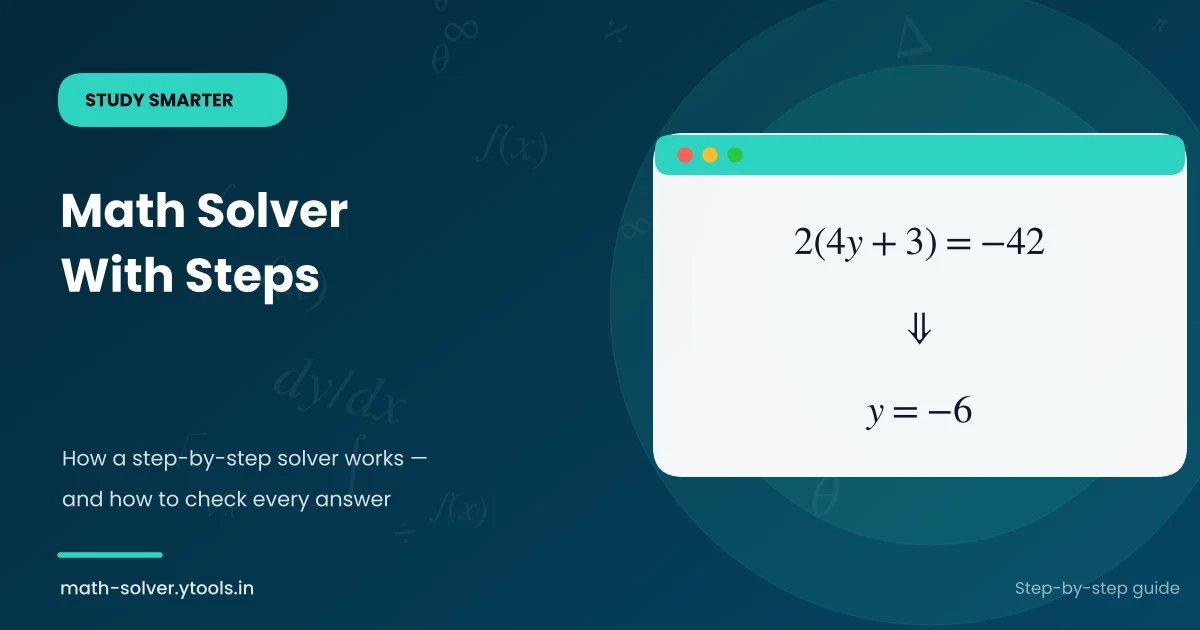
A final answer tells you what; the steps tell you why. That is the real value of a math solver with steps — it turns a single number into a worked solution you can follow, compare with your own work, and learn from. This guide explains what a step-by-step solver does when you press Solve, how to read its output, and four quick ways to check any answer so you never have to take it on trust.
What "with steps" really means
A plain calculator evaluates expressions: type 2*(4*-6+3) and it returns -42. A step-by-step solver goes further. It works on equations and expressions with unknowns, and it records each transformation it makes — expanding brackets, collecting like terms, dividing both sides — so the reasoning is visible. Each line should be equivalent to the one before it: same solutions, simpler form.
What happens when you press "Solve"
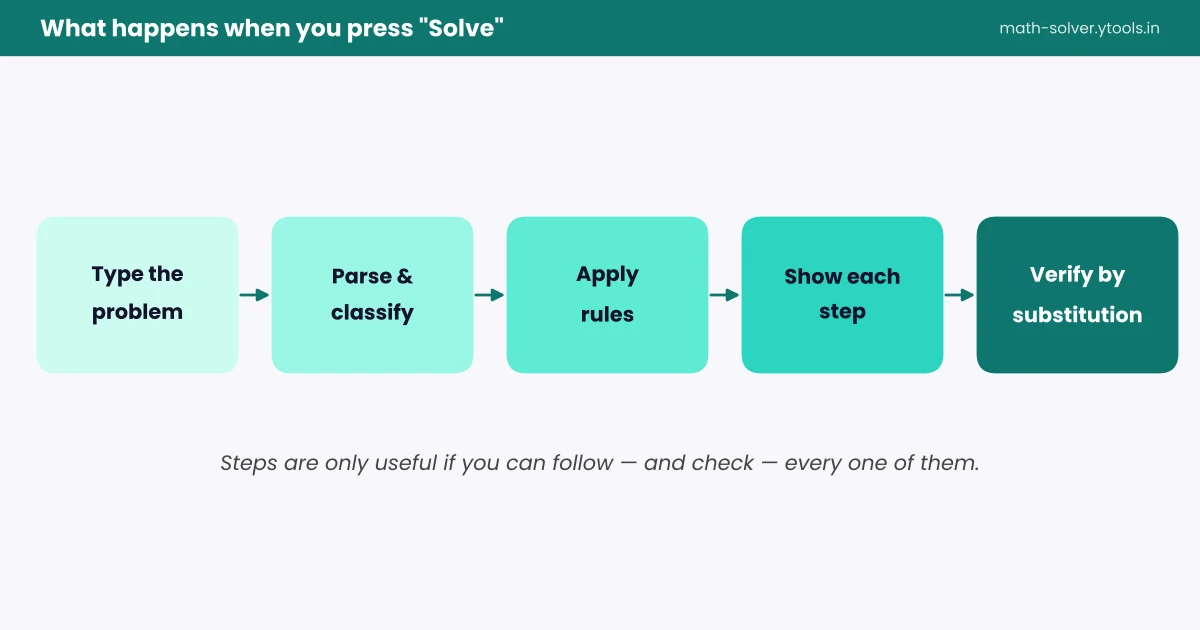
Most step-by-step solvers follow the same broad pipeline:
- Input — you type the problem (or paste it).
- Parse and classify — the solver reads the expression and decides what it is: a linear equation, a quadratic, a derivative, and so on. Typing errors usually fail here.
- Apply rules — it applies standard algebraic or calculus rules in a sensible order.
- Show each step — every rule application becomes a line of working.
- Verify — the answer can be checked by substituting it back.
Knowing this helps you troubleshoot. If the solver misreads your problem, it is almost always step 2: a missing bracket or multiplication sign changes what is being solved.
How to read a step-by-step solution
Here is the kind of equation that students type into solvers every day.
Solve .
| Step | Working | What happened |
|---|---|---|
| 1 | Original equation | |
| 2 | Distributive property: and | |
| 3 | Subtract 6 from both sides | |
| 4 | Divide both sides by 8 |
For each line, ask: what single operation turned the previous line into this one? If you can name it, you understand the step. If you can't, that is exactly the skill to practise — our guide on how to solve for x walks through these moves in detail.
4 ways to check any answer
1. Substitute back into the original
This is the gold standard for equations.
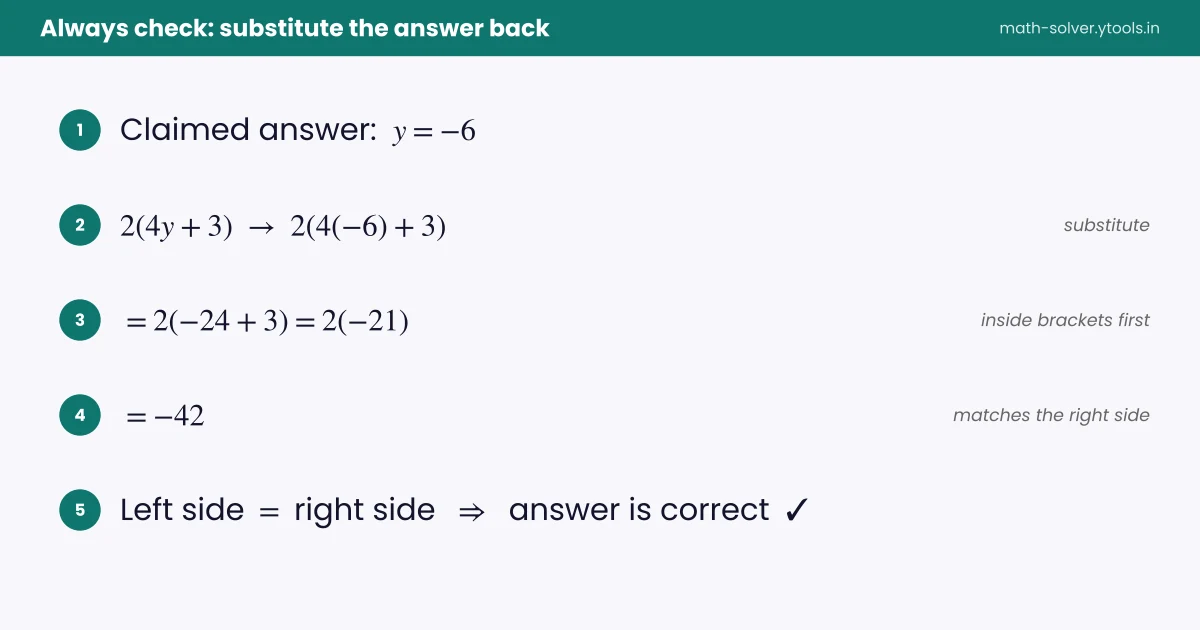
Put into the original equation (not a later line, which might already contain a mistake): . Left side equals right side, so is correct.
Try the same on : the solver gives ; check: ✓.
2. Estimate first
Before solving, guess roughly what the answer should be. For , , so an answer of or is obviously off by a factor of ten.
3. Solve a second way
Many problems have two routes. A quadratic can be solved by factoring and by the quadratic formula; a pair of simultaneous equations by substitution and by elimination. Two methods agreeing is strong evidence.
4. Check the form, not just the value
, and are the same number. and are the same integral. If your answer "doesn't match", simplify both before deciding one is wrong.
When a solver's answer looks wrong but isn't
- Rounding: decimals may be rounded to a fixed number of places; the exact answer might be a fraction or a surd like .
- Equivalent forms: factored vs expanded, or a different but equal constant of integration.
- Domain conditions: an equation such as has two solutions ( and ); a single answer may be incomplete.
- Input ambiguity:
22/2(3+1)can be read differently depending on how implied multiplication is treated. Add brackets to remove doubt.
Using a solver to learn, not just to finish homework
- Attempt the problem on paper first.
- Run it through the step-by-step math solver.
- Find the first line where your work and the solver's differ — that is your learning point.
- Redo a similar problem without help.
For more on this approach, see our math problem-solving strategies. For calculus, the calculus step-by-step guide applies the same idea to derivatives, integrals and limits.
FAQ
What is a math solver with steps? A tool that solves equations or expressions and shows each intermediate transformation, not just the final answer.
Can I trust a math solver's answer? Check it: substitute the answer back into the original equation. If both sides match, the answer is correct regardless of where it came from.
Why is the solver's answer different from mine? It may be an equivalent form (fraction vs decimal, factored vs expanded) or rounded. Simplify both before comparing.
Does a step-by-step solver help me learn? Yes, if you try the problem first and use the steps to find exactly where your method went wrong.
What kinds of problems can it solve? Typically arithmetic, linear and quadratic equations, simultaneous equations and calculus — check the algebra solver tools and calculus tools for the full list.
Why does my typed equation give an error?
Usually a missing bracket or multiplication sign. Write 2*(4*y+3) style input if implicit multiplication isn't recognised.
Conclusion
A math solver with steps is most powerful as a checking and learning tool. Read each line as a single operation, verify with substitution, and use differences between your work and the solver's to find what to practise next.
Further reading: OpenStax Elementary Algebra 2e · Wolfram MathWorld: Linear Equation.
Related Posts
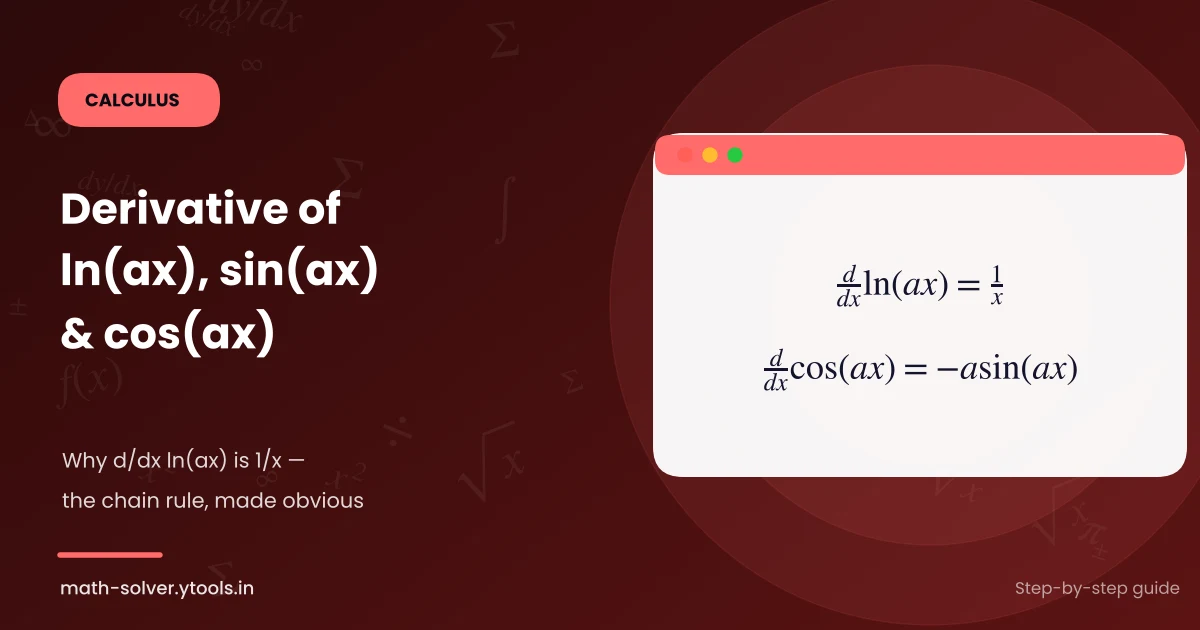
Derivative of ln(ax), sin(ax), cos(ax): Chain Rule Explained
Why d/dx ln(ax) = 1/x, why sin(ax) gives a·cos(ax) and cos(ax) gives −a·sin(ax). One chain-rule pattern, a graph that makes it obvious, and worked examples.
Read More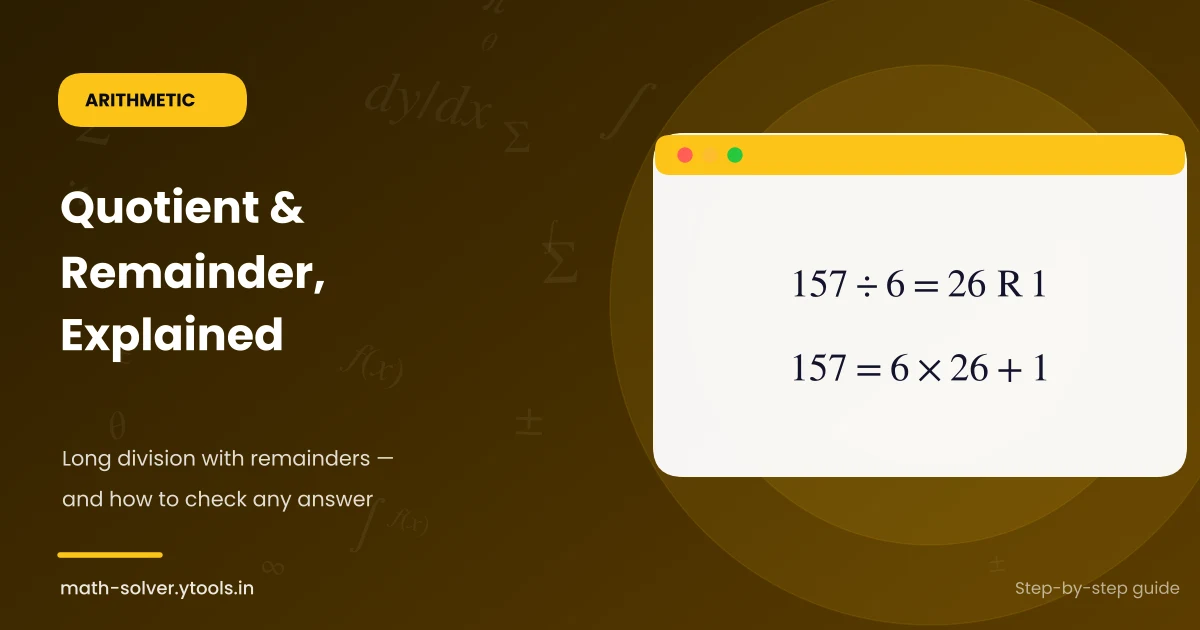
How to Divide With Remainders: Quotient & Remainder Explained
Learn to find the quotient and remainder with long division, check answers with dividend = divisor × quotient + remainder, and write remainders as fractions or decimals.
Read More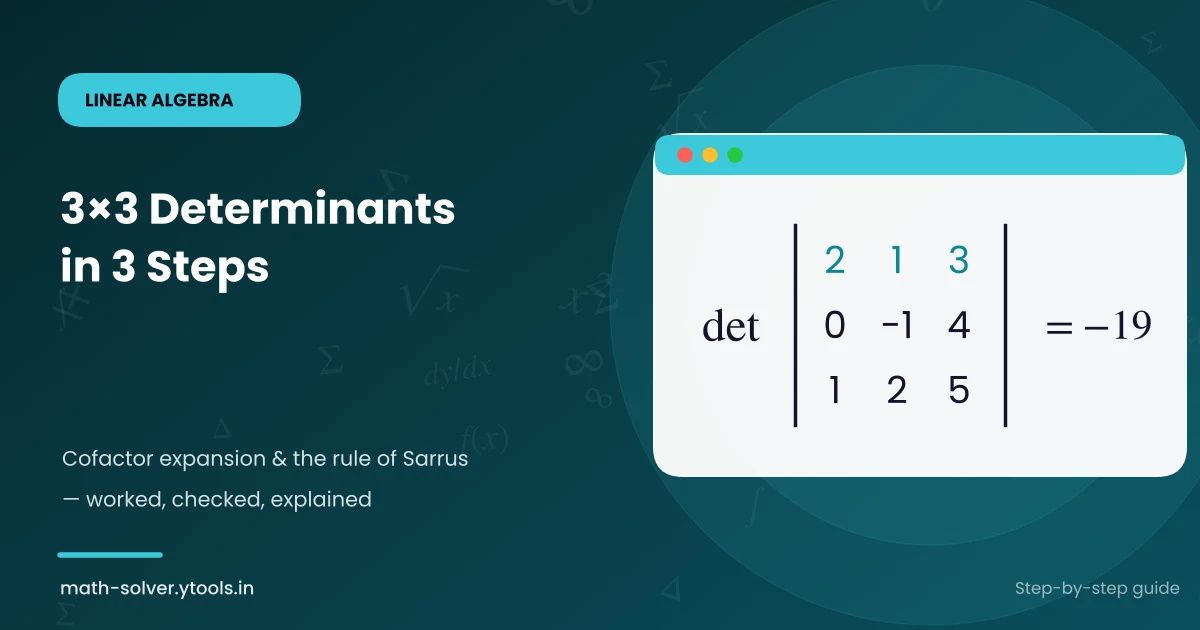
How to Find the Determinant of a 3×3 Matrix (Step by Step)
Find any 3×3 determinant with cofactor expansion, then check it with the rule of Sarrus. Fully worked example, sign pattern, shortcuts and what a zero determinant means.
Read More