Derivative of ln(ax), sin(ax), cos(ax): Chain Rule Explained
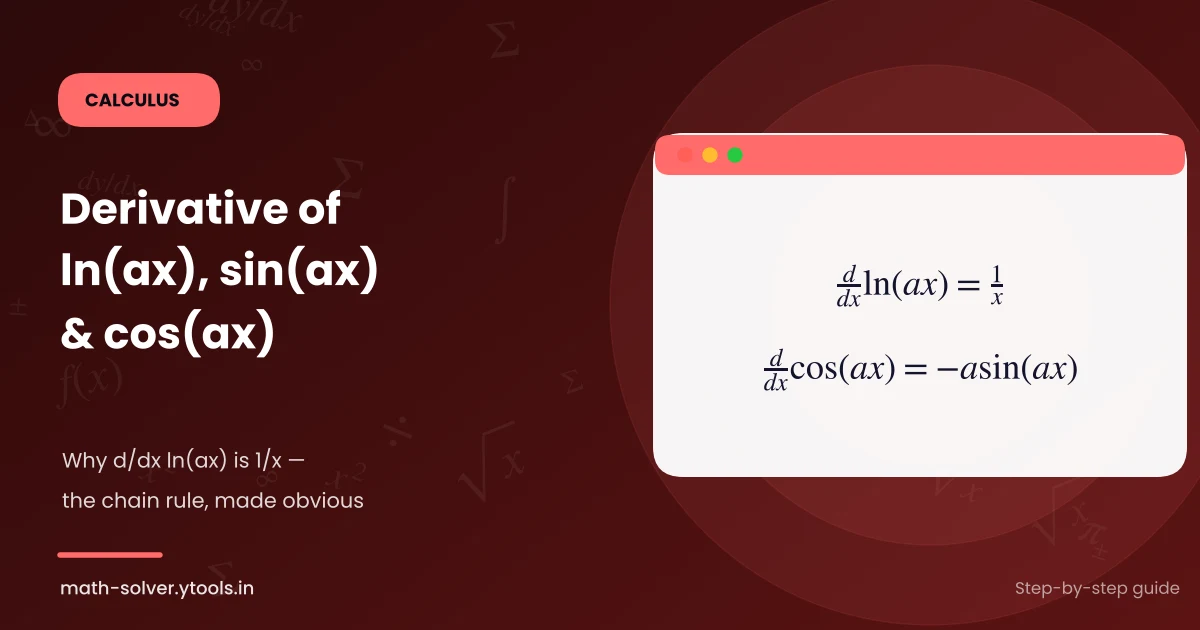
Quick answers (for any non-zero constant , in radians):
The surprising one is the first: the disappears. This guide shows why, using one chain-rule pattern that covers all three — plus , and more.
The one pattern:
When a function has another function inside it, the chain rule says: differentiate the outside, keep the inside, then multiply by the derivative of the inside.
With inside , the inside's derivative is just . So every "" derivative is the normal derivative of , evaluated at , multiplied by .
Derivative of ln(ax) = 1/x
Proof 1 — log laws
For and , . Since is a constant, its derivative is 0:
Proof 2 — chain rule
Outside has derivative ; inside has derivative :
The in the denominator cancels the from the inside. This works whenever — including negative with negative . For example, for , .
The graph that makes it obvious
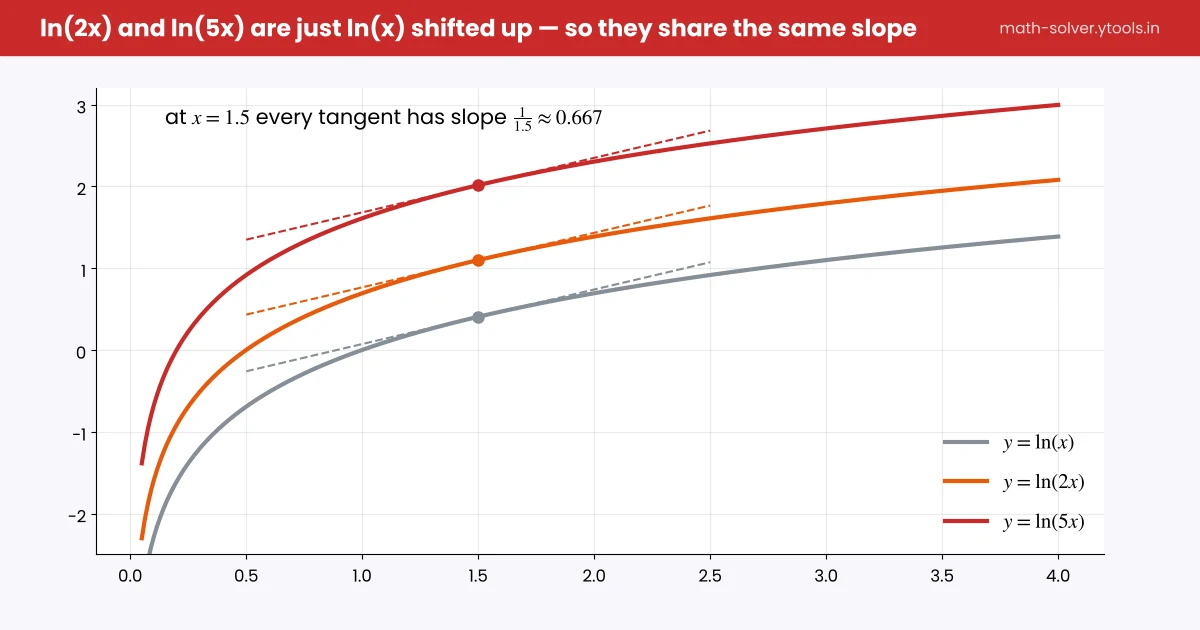
Because , the graph of is just shifted up by . Shifting a curve vertically doesn't change its steepness, so at every the three curves have exactly the same slope. At each tangent has slope .
Example: . At the slope is — the same as for .
Derivative of sin(ax) = a cos(ax)
Outside → ; inside → :
Example: . Geometrically, oscillates 4 times faster than , so its slopes are 4 times steeper.
Derivative of cos(ax) = −a sin(ax)
Outside → ; inside → :
Example: . Don't drop the minus sign — it comes from the derivative of cosine itself.
Cheat sheet
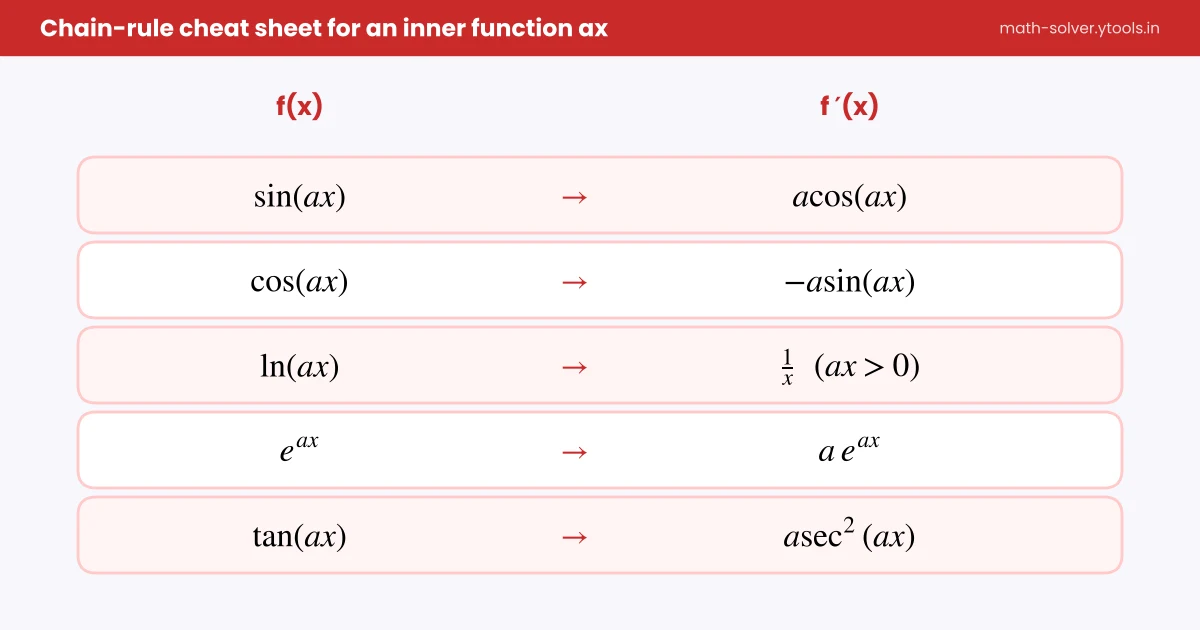
| , | |
| , |
Note the last row: with an added constant , the no longer cancels completely.
Beyond ax: when the inside is more complicated
The same chain rule handles any inside function — you just multiply by its derivative.
Common mistakes
- Answering or for — the correct answer is .
- Forgetting the factor for sin, cos and exp.
- Losing the minus sign on the derivative of cosine.
- Working in degrees. These formulas assume radians; in degrees an extra factor of appears.
Check with a derivative calculator
Use the derivative of ln calculator, the derivative of cos(ax) calculator, the sin derivative calculator or the exponential derivative calculator to confirm each result step by step. For any other inner function, the chain rule calculator shows the outside/inside split. New to derivatives? Start with the calculus step-by-step guide.
FAQ
What is the derivative of ln(ax)? , for any non-zero constant where .
Why doesn't the a appear in the derivative of ln(ax)? Because , and the constant differentiates to zero. With the chain rule, the cancels.
What is the derivative of cos(ax)? .
What is the derivative of sin(ax)? .
What is the derivative of e^(ax)? .
Do these formulas work in degrees? No — they assume radians. In degrees, multiply by an extra .
Further reading: Wolfram MathWorld — Chain Rule · OpenStax Calculus Volume 1, chapter 3.
Related Posts
How to Divide With Remainders: Quotient & Remainder Explained
Learn to find the quotient and remainder with long division, check answers with dividend = divisor × quotient + remainder, and write remainders as fractions or decimals.
Read More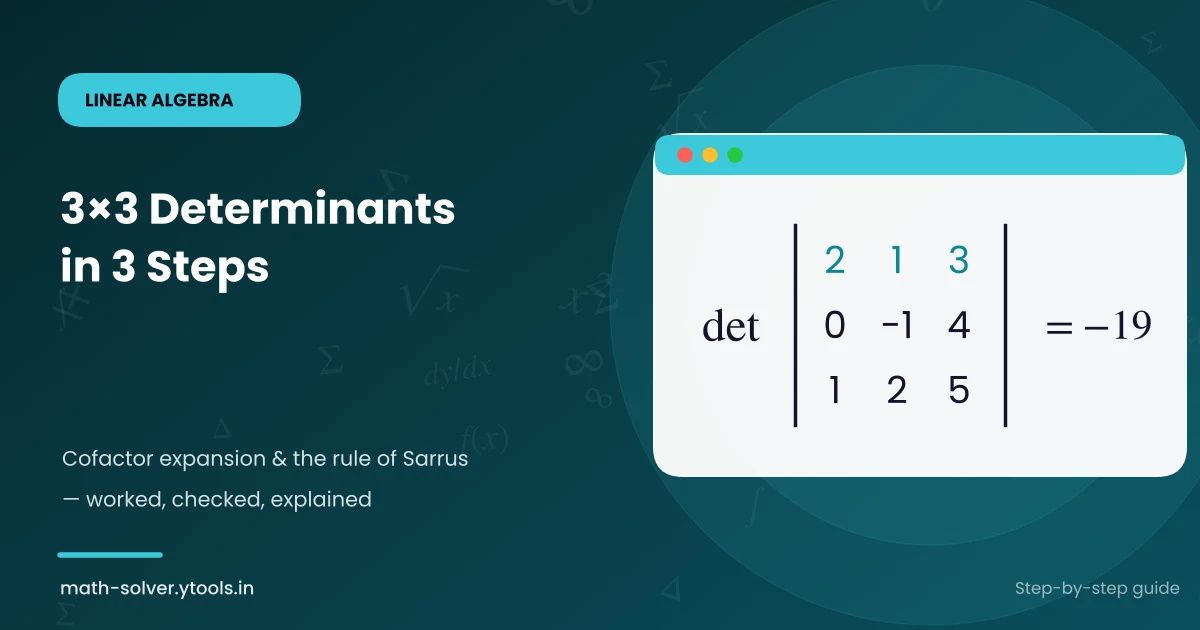
How to Find the Determinant of a 3×3 Matrix (Step by Step)
Find any 3×3 determinant with cofactor expansion, then check it with the rule of Sarrus. Fully worked example, sign pattern, shortcuts and what a zero determinant means.
Read More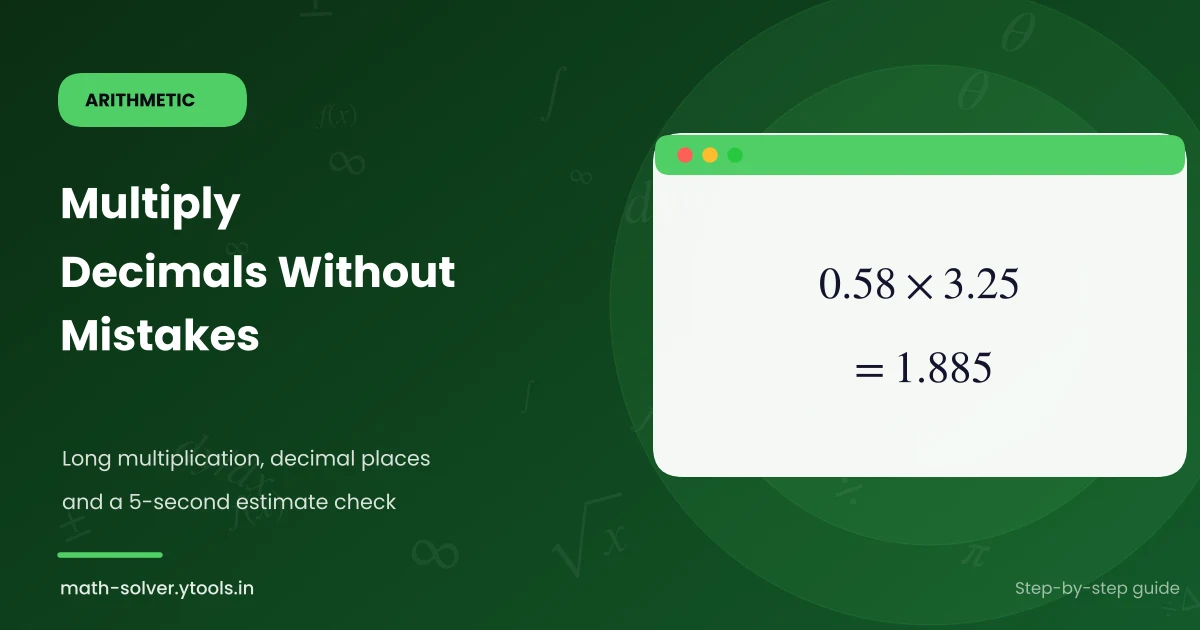
How to Multiply Decimals Step by Step (With Examples)
Multiply any decimals in three steps: multiply as whole numbers, count decimal places, then estimate to check. Worked examples like 0.58 × 3.25 and 0.0945 × 1.47.
Read More