How to Find the Determinant of a 3×3 Matrix (Step by Step)

A 3×3 determinant is a single number calculated from the nine entries of a square matrix. It tells you whether the matrix has an inverse and is used to solve systems of equations. Below are two methods — cofactor expansion, which works for any size, and the rule of Sarrus, a quick 3×3-only check — worked on the same matrix so you can see they agree.
We'll use
First, the 2×2 determinant
Everything builds on this:
For example, .
Method 1 — Cofactor expansion in 3 steps
Step 1 — Pick a row and use the sign pattern
Each position has a sign:
We'll expand along the first row, so the signs are .
Step 2 — Find each 2×2 minor
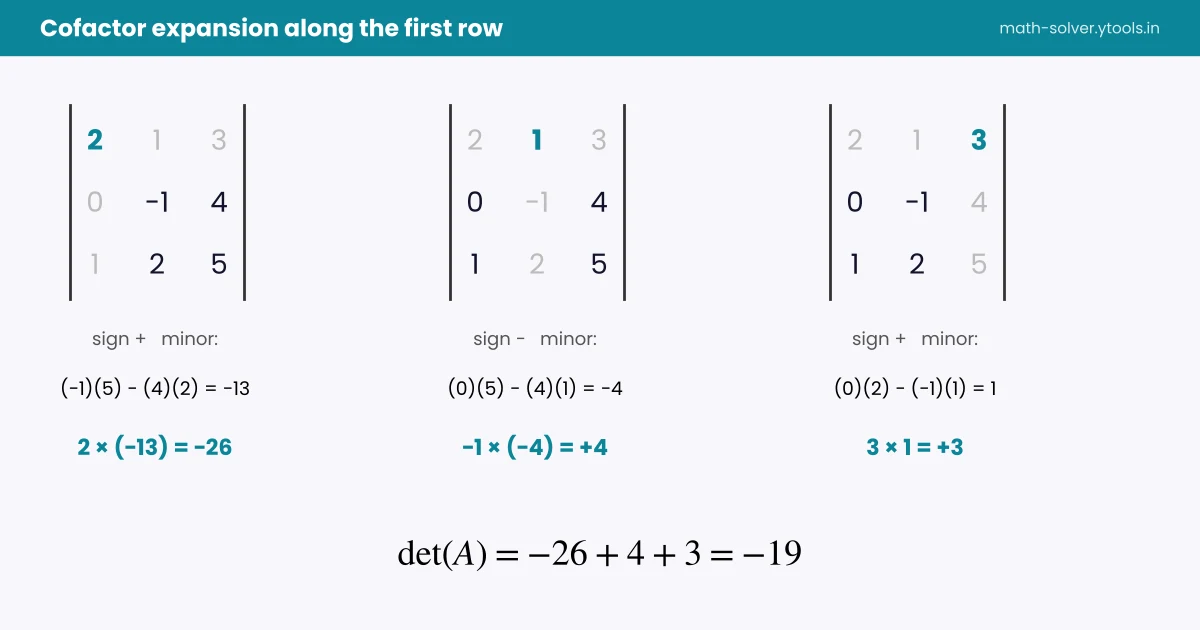
For each entry in the row, cover its row and column; the 2×2 that remains is its minor.
| Entry | Sign | Minor | Minor's value |
|---|---|---|---|
Step 3 — Multiply and add
Method 2 — The rule of Sarrus (3×3 only)
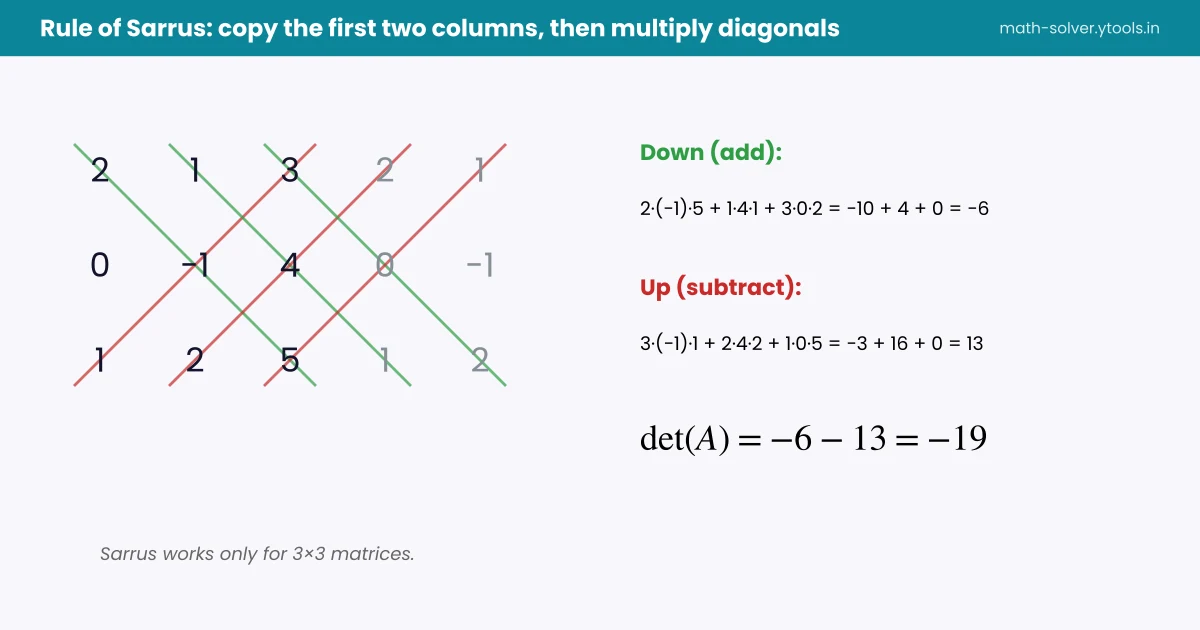
- Copy the first two columns to the right of the matrix.
- Add the three downward-diagonal products: .
- Subtract the three upward-diagonal products: .
- ✓ — the same answer.
Warning: Sarrus' rule does not extend to 4×4 or larger matrices. Use cofactor expansion (or row reduction) for those.
Shortcut: expand along the row or column with the most zeros
You can expand along any row or column — the answer is the same. Zeros save work, because their terms vanish. Column 1 of is , with signs :
Three methods, one answer — a strong check.
What does the determinant tell you?
- : the matrix is invertible, and a system of equations with this coefficient matrix has exactly one solution.
- : the matrix is singular — no inverse. For example, , because the rows are linearly dependent (row 3 = 2 × row 2 − row 1).
- Geometric meaning: is the factor by which the matrix scales volume; a negative sign means orientation is flipped.
- Determinants also power Cramer's rule for solving systems — see solving simultaneous equations.
Common mistakes
- Forgetting the minus sign on the middle term of row 1.
- Mixing up (writing ).
- Sign slips with negative entries: .
- Using Sarrus' rule on a 4×4 matrix.
Use the 3×3 determinant calculator
Enter your matrix in the 3×3 determinant calculator with steps to see every minor and cofactor. For smaller matrices use the 2×2 determinant calculator; to invert a 2×2, try the matrix inverse calculator. More tools are in linear algebra.
FAQ
How do you find the determinant of a 3×3 matrix? Expand along a row: multiply each entry by its signed 2×2 minor () and add the results.
What is the rule of Sarrus? A 3×3-only shortcut: copy the first two columns, add the three downward diagonal products and subtract the three upward ones.
Which row should I expand along? Any row or column gives the same result; choose the one with the most zeros.
What does a determinant of 0 mean? The matrix has no inverse, and the corresponding system of equations has either no solution or infinitely many.
Can a determinant be negative? Yes. The sign indicates orientation; the absolute value is the volume scale factor.
Is there a 3×3 determinant calculator with steps? Yes — the 3×3 determinant calculator shows the expansion.
Further reading: Wolfram MathWorld — Determinant · OpenStax College Algebra 2e.
Related Posts

Derivative of ln(ax), sin(ax), cos(ax): Chain Rule Explained
Why d/dx ln(ax) = 1/x, why sin(ax) gives a·cos(ax) and cos(ax) gives −a·sin(ax). One chain-rule pattern, a graph that makes it obvious, and worked examples.
Read More
How to Divide With Remainders: Quotient & Remainder Explained
Learn to find the quotient and remainder with long division, check answers with dividend = divisor × quotient + remainder, and write remainders as fractions or decimals.
Read More
How to Multiply Decimals Step by Step (With Examples)
Multiply any decimals in three steps: multiply as whole numbers, count decimal places, then estimate to check. Worked examples like 0.58 × 3.25 and 0.0945 × 1.47.
Read More