How to Divide With Remainders: Quotient & Remainder Explained
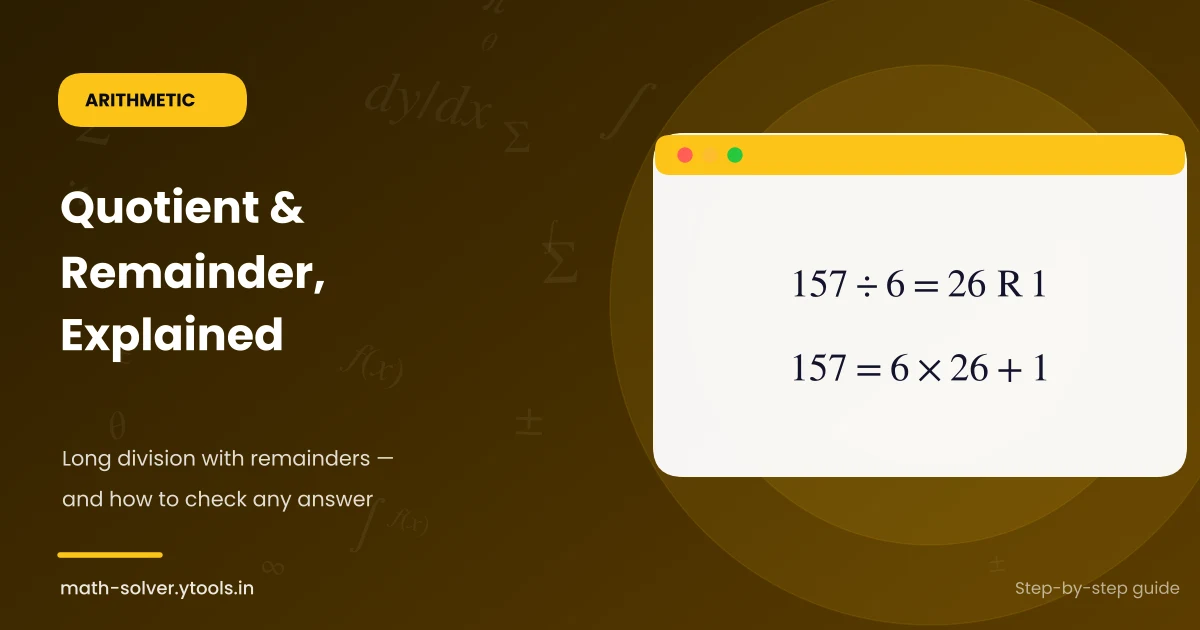
When one whole number doesn't divide another exactly, you get two answers: how many whole times it fits (the quotient) and what's left over (the remainder). This guide shows how to find both with long division, how to check them in one line, and what to do with the remainder in real problems.
The four parts of a division
In :
| Part | Meaning | Here |
|---|---|---|
| Dividend | the number being divided | 157 |
| Divisor | the number you divide by | 6 |
| Quotient | how many whole times the divisor fits | 26 |
| Remainder | what is left over | 1 |
The remainder must always be smaller than the divisor. If it isn't, the divisor fits at least once more.
The one-line check
Every correct division with a remainder satisfies
For : ✓. This is the fastest way to check any answer — including one from a calculator.
Picture it:
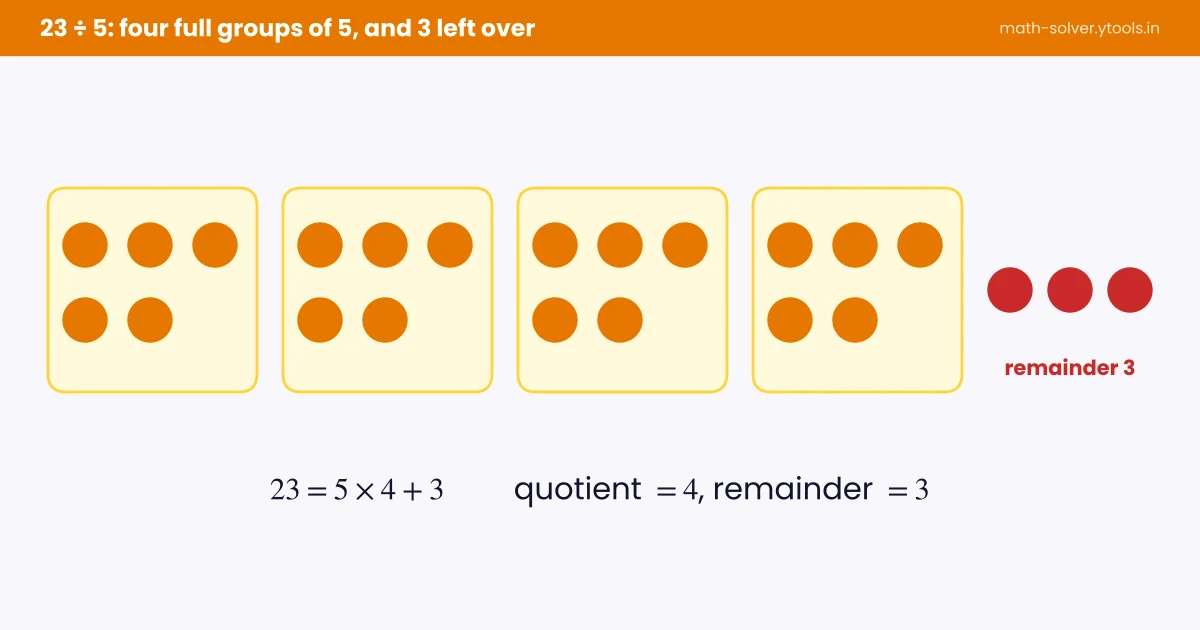
Share 23 counters into groups of 5. You can make 4 full groups (20 counters), and 3 are left over. So , and ✓.
Long division with remainders step by step
Long division repeats four actions — divide, multiply, subtract, bring down — one digit at a time.
Worked example:
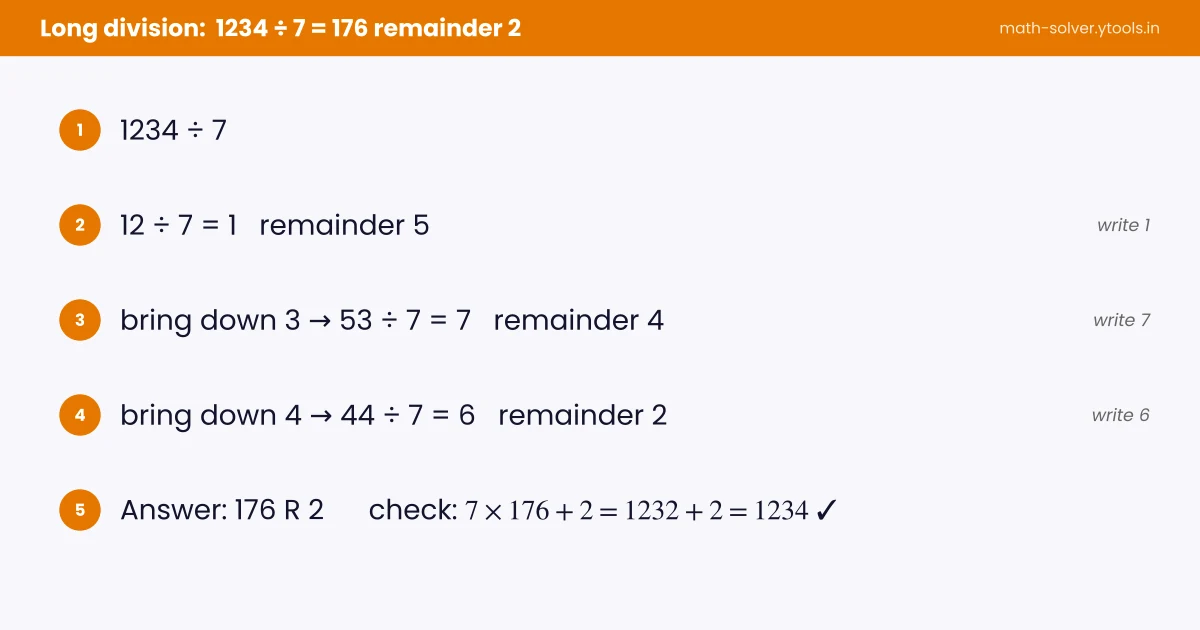
- 7 doesn't go into 1, so look at 12. (write 1). ; .
- Bring down 3 → 53. (write 7). ; .
- Bring down 4 → 44. (write 6). ; .
- No digits left, so the remainder is 2.
Answer: . Check: ✓.
Worked example:
- ; ; .
- Bring down 7 → . ; ; .
Answer: .
Writing the remainder as a fraction or decimal
Put the remainder over the divisor:
To get the decimal by long division, add a decimal point and zeros to the dividend and keep going.
Word problems: round up, round down or keep the remainder?
The context decides what the remainder means:
- 157 pencils packed 6 to a box — how many full boxes? 26 (round down).
- How many boxes to hold all the pencils? 27 (round up — the last pencil still needs a box).
- How many pencils are left over? 1 (the remainder itself).
Negative numbers (an edge case)
With negatives, conventions differ. In mathematics the remainder is usually kept non-negative: , so the quotient is and the remainder is . Many programming languages instead truncate towards zero and give quotient , remainder (since ). Both satisfy dividend = divisor × quotient + remainder; check which convention your course or software uses.
Common mistakes
- Leaving a remainder that is bigger than the divisor.
- Forgetting to write a 0 in the quotient when the divisor doesn't fit (e.g. , not ).
- Subtracting incorrectly and carrying the error through every later step.
- Writing the remainder as a decimal directly ( is , not ).
Use the quotient and remainder calculator
Enter any dividend and divisor in the quotient and remainder calculator to see the long division and the check line. For decimal answers use the division calculator. Remainders also power Euclid's algorithm, which the HCF / GCD calculator uses to find the highest common factor.
FAQ
How do you find the quotient and remainder? Divide to find how many whole times the divisor fits (quotient), multiply back, and subtract from the dividend to get the remainder.
How do I check a division with a remainder? Multiply the divisor by the quotient and add the remainder. You should get the dividend.
Can the remainder be bigger than the divisor? No. If it is, the quotient is too small by at least one.
What is 1234 divided by 7 with remainder? remainder .
How do I write a remainder as a fraction? Place the remainder over the divisor: in becomes .
What does R mean in division? "R" stands for remainder: means 4 groups with 3 left over.
Further reading: Wolfram MathWorld — Remainder, Long Division · OpenStax Prealgebra 2e.
Related Posts
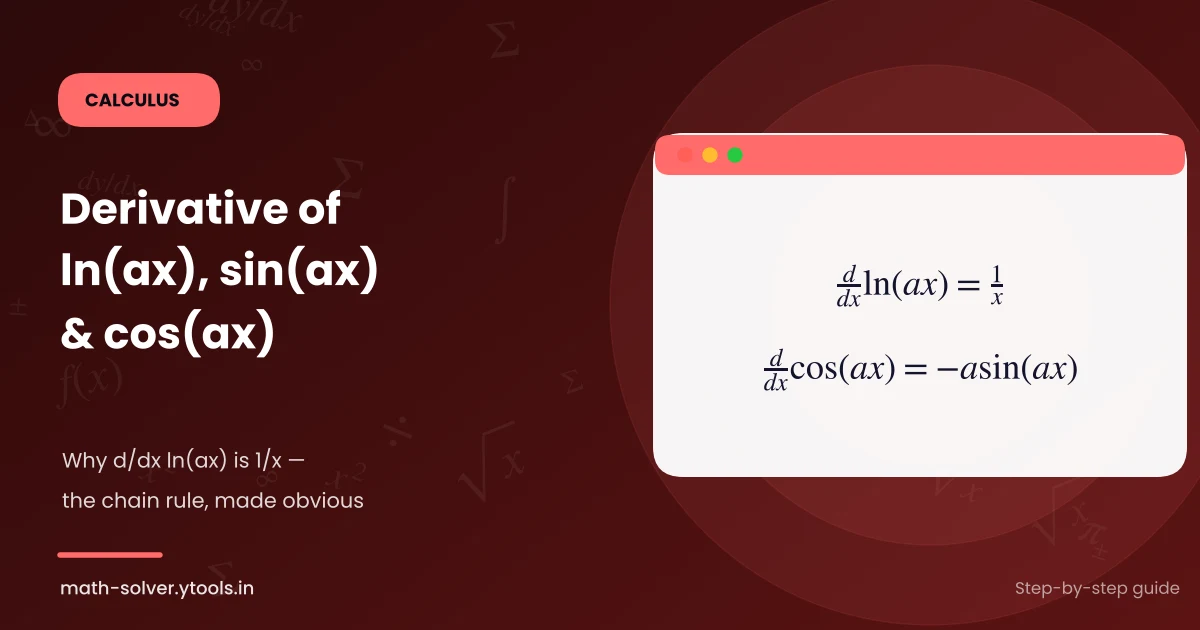
Derivative of ln(ax), sin(ax), cos(ax): Chain Rule Explained
Why d/dx ln(ax) = 1/x, why sin(ax) gives a·cos(ax) and cos(ax) gives −a·sin(ax). One chain-rule pattern, a graph that makes it obvious, and worked examples.
Read More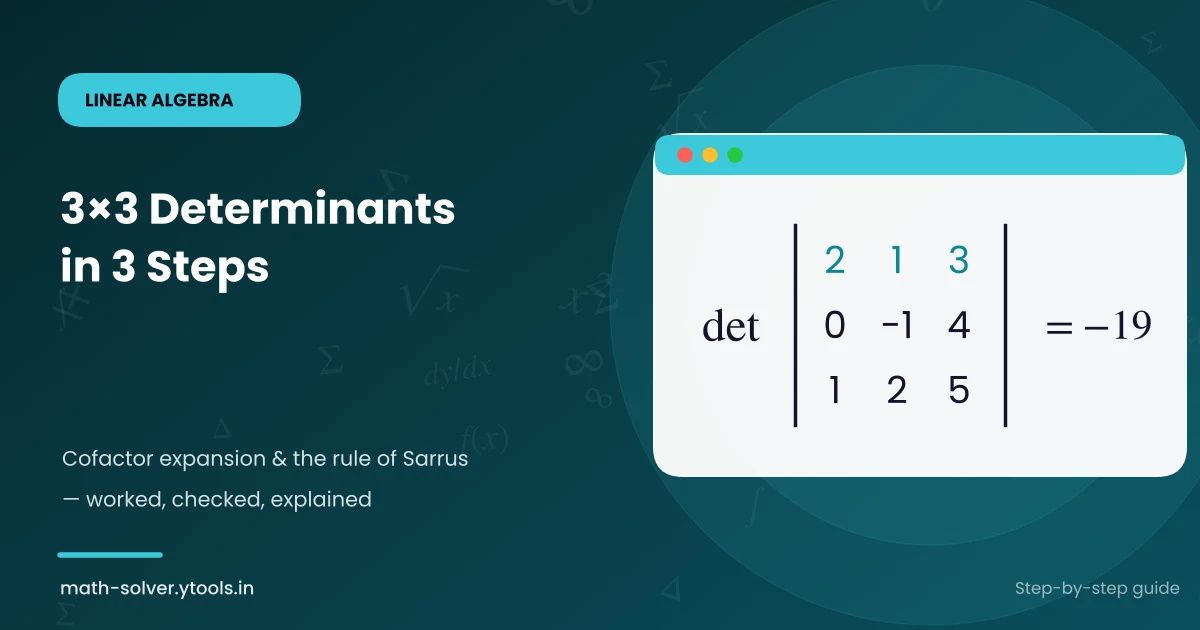
How to Find the Determinant of a 3×3 Matrix (Step by Step)
Find any 3×3 determinant with cofactor expansion, then check it with the rule of Sarrus. Fully worked example, sign pattern, shortcuts and what a zero determinant means.
Read More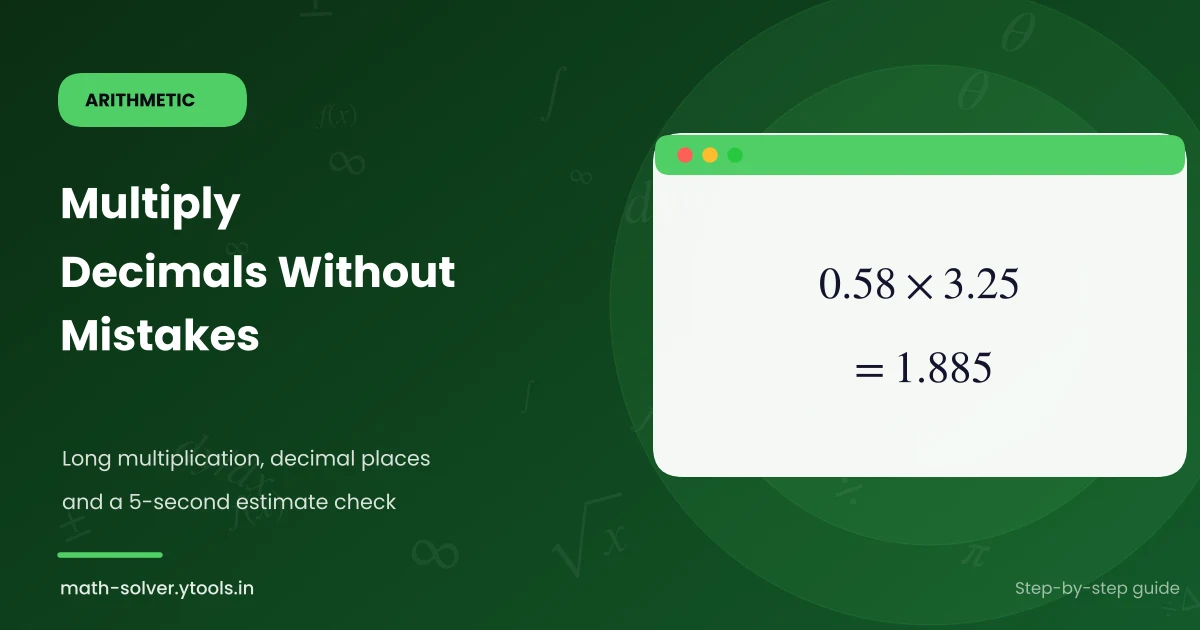
How to Multiply Decimals Step by Step (With Examples)
Multiply any decimals in three steps: multiply as whole numbers, count decimal places, then estimate to check. Worked examples like 0.58 × 3.25 and 0.0945 × 1.47.
Read More