How to Solve Calculus Problems Step by Step (With Examples)
Most calculus homework looks harder than it is because the first move is unclear. Once you know which kind of problem you are looking at, each one follows a short, repeatable routine. This guide gives you that routine for the three problem types you will meet most often — derivatives, integrals and limits — with a fully worked example for each and a way to check every answer yourself.
Step 1 — Identify the type of calculus problem
Read the question and ask what it actually wants to know:
- "How fast is something changing?" — a slope, speed, rate or gradient. That is a derivative.
- "How much is there in total?" — an area, distance travelled, accumulated amount. That is an integral.
- "What value does this get close to?" — usually a fraction that breaks when you plug the number straight in. That is a limit.
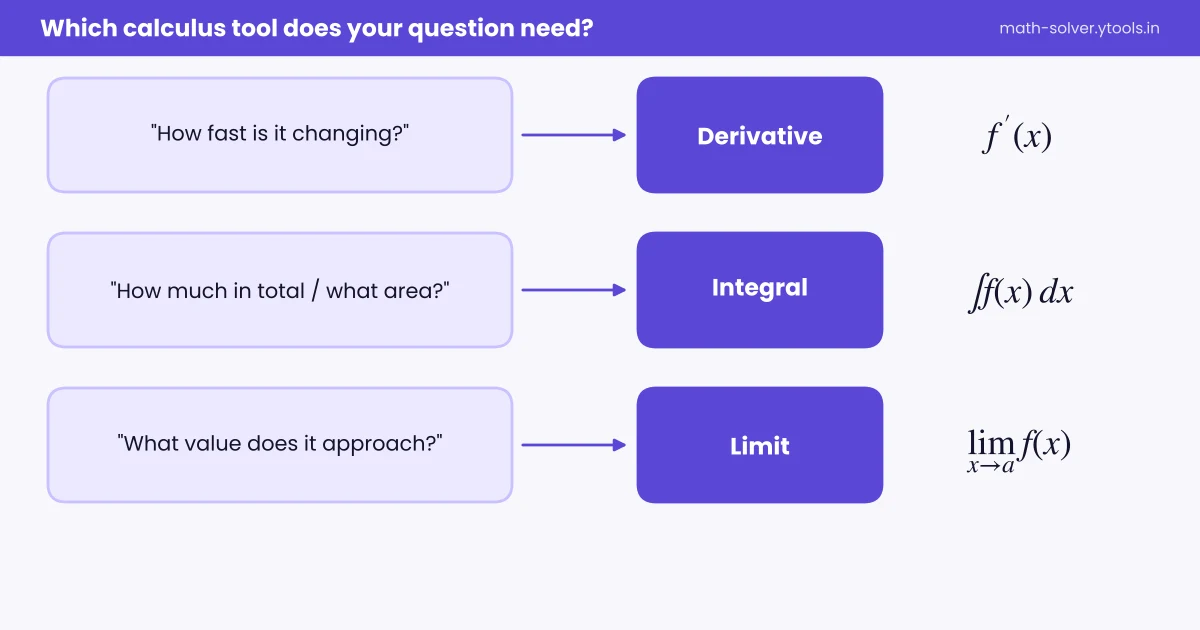
Words in the question are strong clues: rate, slope, tangent, maximum, minimum point to derivatives; area, total, accumulated, volume point to integrals; approaches, tends to, as x gets close to point to limits.
How to solve a derivative step by step
A derivative measures the instantaneous rate of change of a function — geometrically, the slope of the tangent line at a point. For polynomials you only need three rules:
| Rule | Formula |
|---|---|
| Power rule | |
| Constant multiple | |
| Sum rule |
Worked example: differentiate
- Split with the sum rule: .
- Power rule on the first term: .
- Power rule on the second term (): .
- Combine: .
At the slope is . If a function contains a "function inside a function", such as or , you also need the chain rule — see our guide to derivatives of ln(ax), sin(ax) and cos(ax). For quick power-rule checks, the power rule calculator shows each step.
How to solve an integral step by step
Integration reverses differentiation. An indefinite integral asks "which function has this derivative?", and because any constant disappears when you differentiate, every answer ends with .
The reverse power rule is:
Worked example:
- Integrate term by term: .
- .
- .
- Add the constant: .
Check: differentiate the answer. ✓ — this is the fastest way to verify any integral.
Definite integrals: the area under from 0 to 2
A definite integral has limits and gives a number. By the Fundamental Theorem of Calculus, find an antiderivative and compute :
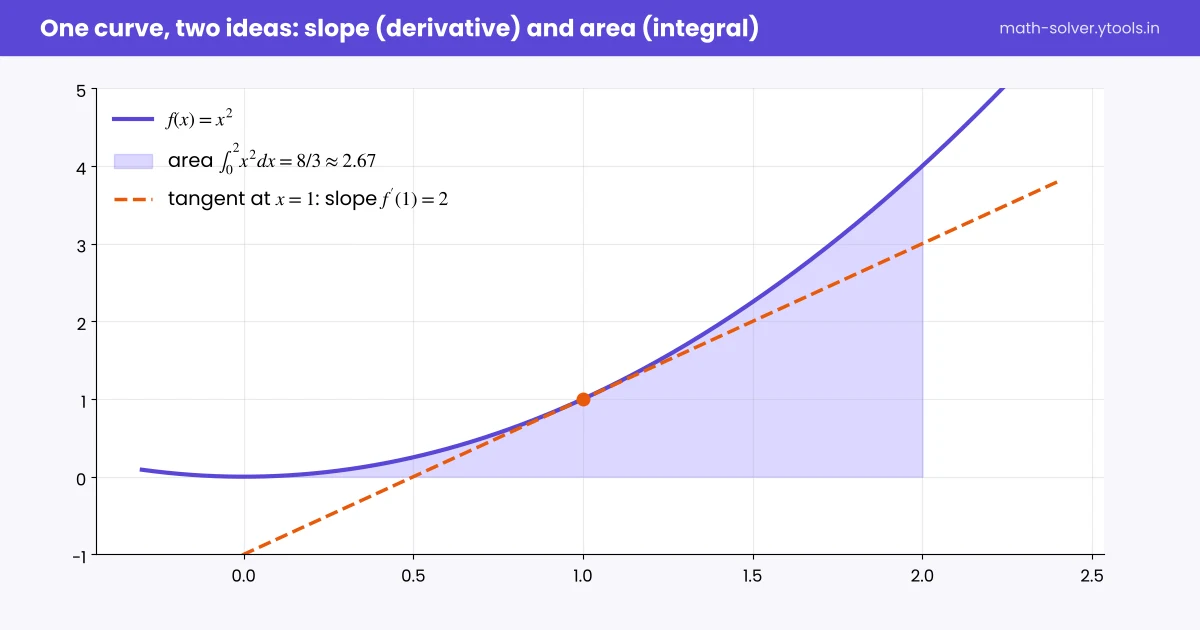
The picture shows both ideas on one curve: the dashed tangent at has slope (derivative), and the shaded region has area (integral). You can reproduce this with the definite integral calculator.
How to solve a limit step by step
Try direct substitution first
If plugging the value in gives an ordinary number, that number is the limit. For example, .
Worked example: when substitution gives 0/0
Find .
- Substitute : — an indeterminate form, so more work is needed.
- Factor the numerator: .
- Cancel the common factor (allowed because while approaching 2): .
- Substitute again: .
So . A numerical sanity check: at the original fraction equals . Our limits and continuity guide covers other techniques, and the limit calculator shows the steps.
How to check your answer
- Derivative: pick a value of , compute with a small (like 0.001) and compare.
- Integral: differentiate your answer; you should get back the original function.
- Limit: evaluate the original expression at values very close to the target from both sides.
Common mistakes
- Forgetting on indefinite integrals.
- Applying the power rule to when integrating (, not ).
- Cancelling terms instead of factors (you can cancel from , but not the "2"s from ).
- Concluding a limit "does not exist" just because substitution gave .
- Dropping the inner derivative when the chain rule is needed.
Using a calculus solver with steps (and when not to)
A good solver is most useful after you have tried the problem: compare your steps line by line and find exactly where you diverged. Use the calculus solver with steps to check derivatives, integrals and limits. Be aware of its limits: answers may be shown in a different but equivalent form (for example vs ), decimals may be rounded, and the solver cannot know the conditions in a word problem unless you include them.
FAQ
How do I know if a problem needs a derivative or an integral? Derivatives answer "how fast is it changing?"; integrals answer "how much in total?". Look for words like rate and slope versus area and total.
What is the easiest way to check an integral? Differentiate your answer. If you get back the function you started with, the integral is correct.
Why does an indefinite integral need + C? Constants differentiate to zero, so infinitely many functions share the same derivative. represents all of them.
What does 0/0 mean in a limit? It is an indeterminate form: it tells you substitution alone isn't enough, not that the limit doesn't exist. Factor, simplify or use another technique.
Can a calculus solver show the steps? Yes — step-by-step solvers display each rule applied. Use them to check your own working rather than to replace it.
Is the derivative the same as the slope? The derivative at a point equals the slope of the tangent line to the curve at that point.
Conclusion
Every calculus problem starts with the same question: rate, total or approach? Answer that, apply the matching rule, and check by differentiating back or plugging in nearby numbers. When you want a second opinion, run the problem through the calculus solver and compare each step.
Further reading: OpenStax Calculus Volume 1 · Wolfram MathWorld: Derivative, Integral.
Related Posts
Derivative of ln(ax), sin(ax), cos(ax): Chain Rule Explained
Why d/dx ln(ax) = 1/x, why sin(ax) gives a·cos(ax) and cos(ax) gives −a·sin(ax). One chain-rule pattern, a graph that makes it obvious, and worked examples.
Read More
How to Divide With Remainders: Quotient & Remainder Explained
Learn to find the quotient and remainder with long division, check answers with dividend = divisor × quotient + remainder, and write remainders as fractions or decimals.
Read More
How to Find the Determinant of a 3×3 Matrix (Step by Step)
Find any 3×3 determinant with cofactor expansion, then check it with the rule of Sarrus. Fully worked example, sign pattern, shortcuts and what a zero determinant means.
Read More