How to Solve for x Step by Step (Brackets, Fractions, Decimals)
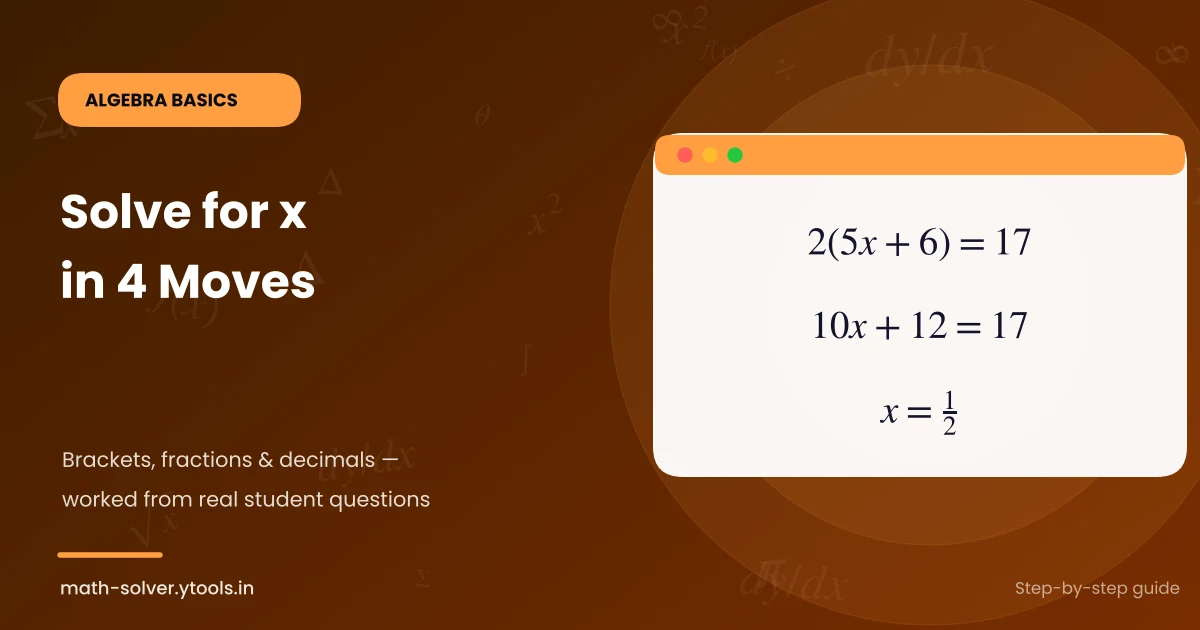
"Solve for x" means finding the value of the unknown that makes both sides of the equation equal. For linear equations — where appears only to the first power — the same four moves work every time, whether the equation has brackets, fractions, decimals or on both sides. Below you'll find the method and five worked examples taken from the kinds of equations students actually search for.
The golden rule: do the same to both sides
An equation is a balance. Whatever you do to one side — add, subtract, multiply or divide by a non-zero number — you must do to the other. Each move produces a simpler equation with the same solution.
The 4-move method (+ check)
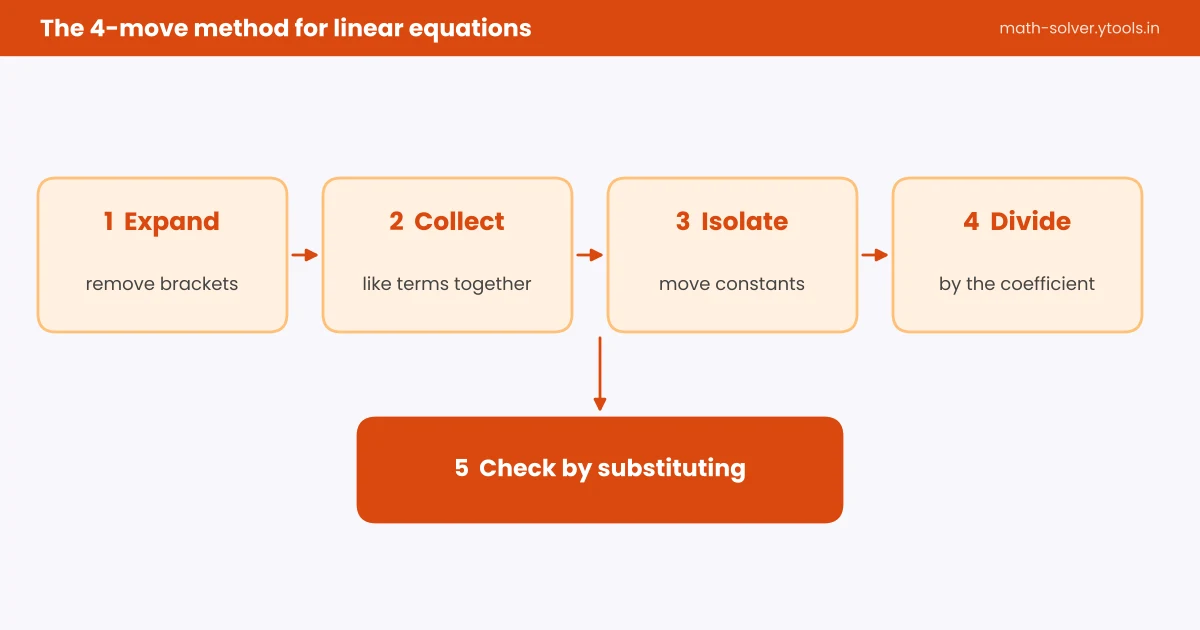
- Expand — remove brackets using the distributive property: .
- Collect — gather -terms on one side and numbers on the other.
- Isolate — use addition or subtraction to leave the -term alone.
- Divide — divide by the coefficient of .
- Check — substitute your answer into the original equation.
Worked examples
Example 1 — brackets:
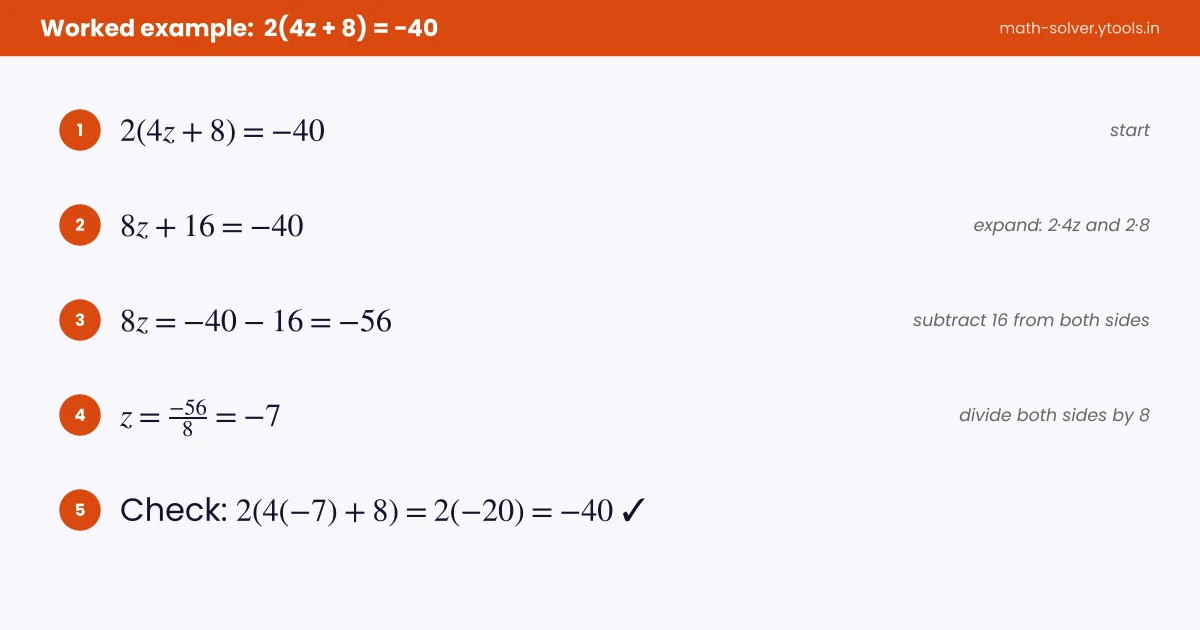
- Expand:
- Subtract 16 from both sides:
- Divide by 8:
- Check: ✓
The same method solves (answer ) and (answer ). Try them before reading on.
Example 2 — the answer is a fraction:
- Expand:
- Subtract 12:
- Divide by 10:
- Check: ✓
Answers don't have to be whole numbers. Leave them as simplified fractions unless the question asks for decimals.
Example 3 — a fractional coefficient:
- Subtract 24 from both sides:
- Multiply both sides by (the reciprocal):
- Check: ✓
Tip: multiplying by the reciprocal of the coefficient is the same as dividing by it, and it keeps fractions tidy.
Example 4 — decimals:
- Add 2.4 to both sides:
- Divide by :
- Check: ✓
If decimals make you nervous, multiply every term by 100 first: . The answer is the same.
Example 5 — variable on both sides:
- Expand:
- Collect -terms on the left:
- Subtract from both sides:
- Add 0.66:
- Divide:
- Check: and ✓
A simpler one to practise: gives , so and .
Special cases: no solution and infinitely many solutions
Sometimes the variable disappears:
- → → , which is false. No solution.
- → , always true. Infinitely many solutions (every works).
Common mistakes
- Expanding only the first term: is , not .
- Sign errors when moving terms: subtracting 16 from gives , not .
- Dividing only part of a side: in , divide the whole right side by 8.
- Checking in a later line instead of the original equation — a mistake made earlier won't show up.
Solve for x with a calculator that shows steps
When you want to check your work, enter the equation in the linear equation solver and compare each line with the four moves. Our linear equation solver guide explains how to type equations with brackets and fractions. Once one unknown is comfortable, move on to two equations with two unknowns or quadratic equations.
FAQ
How do you solve for x step by step? Expand brackets, collect like terms, isolate the -term, divide by its coefficient, then substitute back to check.
How do I solve for y instead of x? Exactly the same way — the letter doesn't matter. Treat , , or as the unknown.
What if x is on both sides? Move all -terms to one side (by adding or subtracting them) before isolating.
How do I solve equations with fractions? Multiply both sides by the reciprocal of the coefficient, or multiply every term by the lowest common denominator to clear the fractions first.
Can an equation have no solution? Yes. If the variable cancels and you're left with a false statement like , there is no solution.
Is there a solve for x calculator with steps? Yes — the linear equation solver shows each step so you can compare it with your own working.
Conclusion
Expand, collect, isolate, divide — then check. Those four moves solve every linear equation, from to equations with decimals and unknowns on both sides. Practise a few by hand, then use the solver to confirm.
Further reading: OpenStax Elementary Algebra 2e, chapter 2.
Related Posts
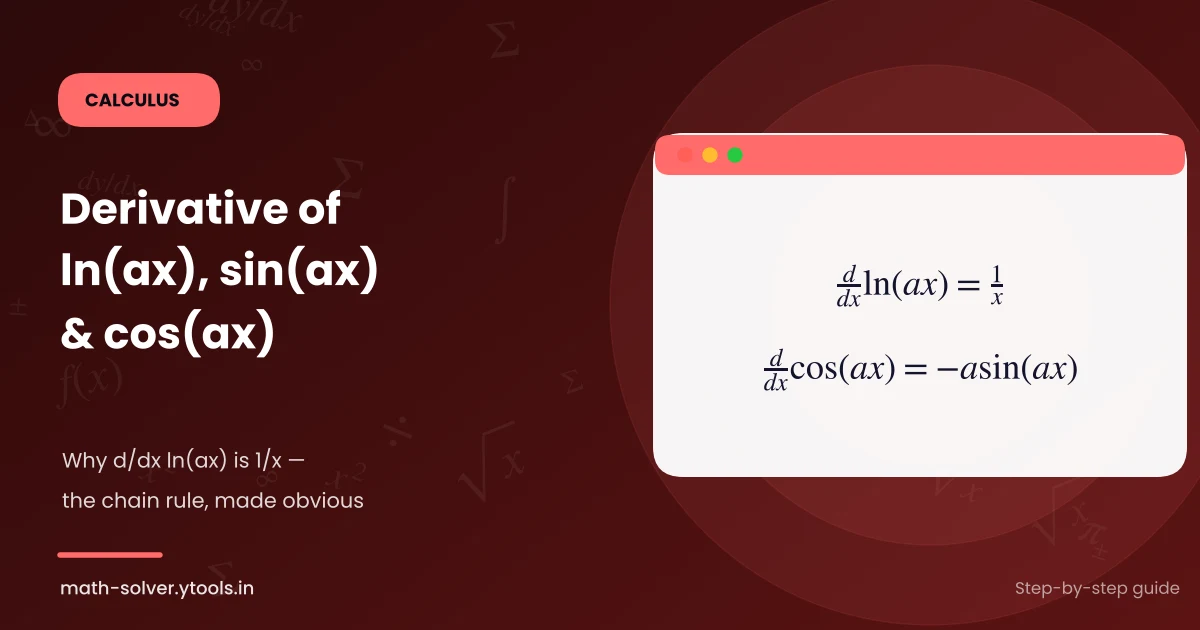
Derivative of ln(ax), sin(ax), cos(ax): Chain Rule Explained
Why d/dx ln(ax) = 1/x, why sin(ax) gives a·cos(ax) and cos(ax) gives −a·sin(ax). One chain-rule pattern, a graph that makes it obvious, and worked examples.
Read More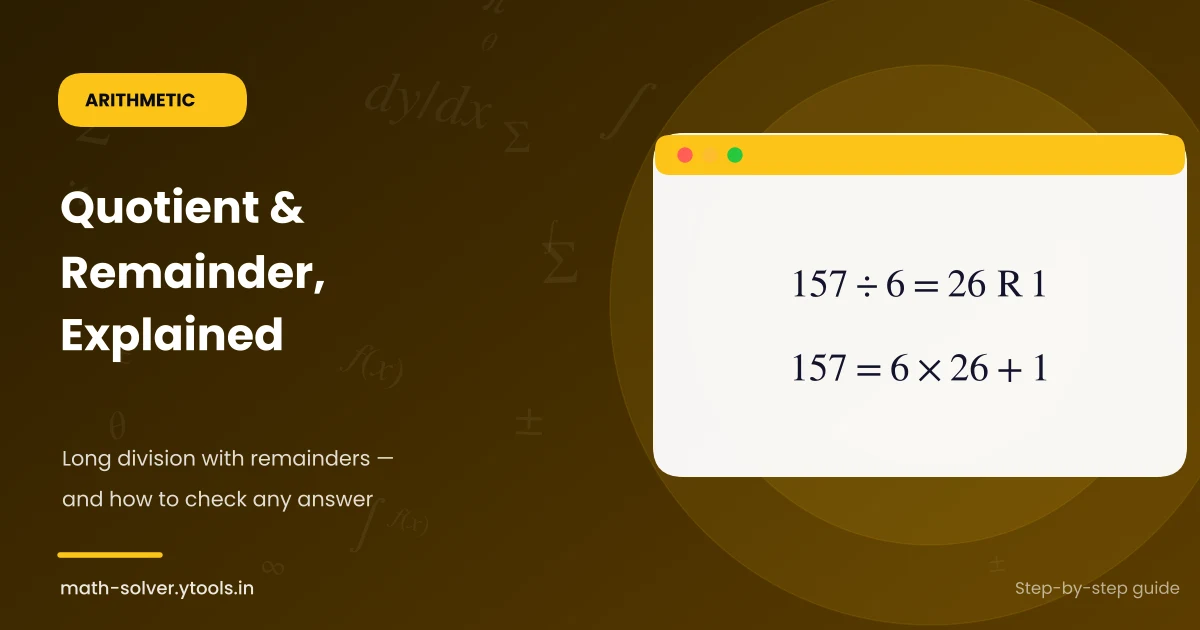
How to Divide With Remainders: Quotient & Remainder Explained
Learn to find the quotient and remainder with long division, check answers with dividend = divisor × quotient + remainder, and write remainders as fractions or decimals.
Read More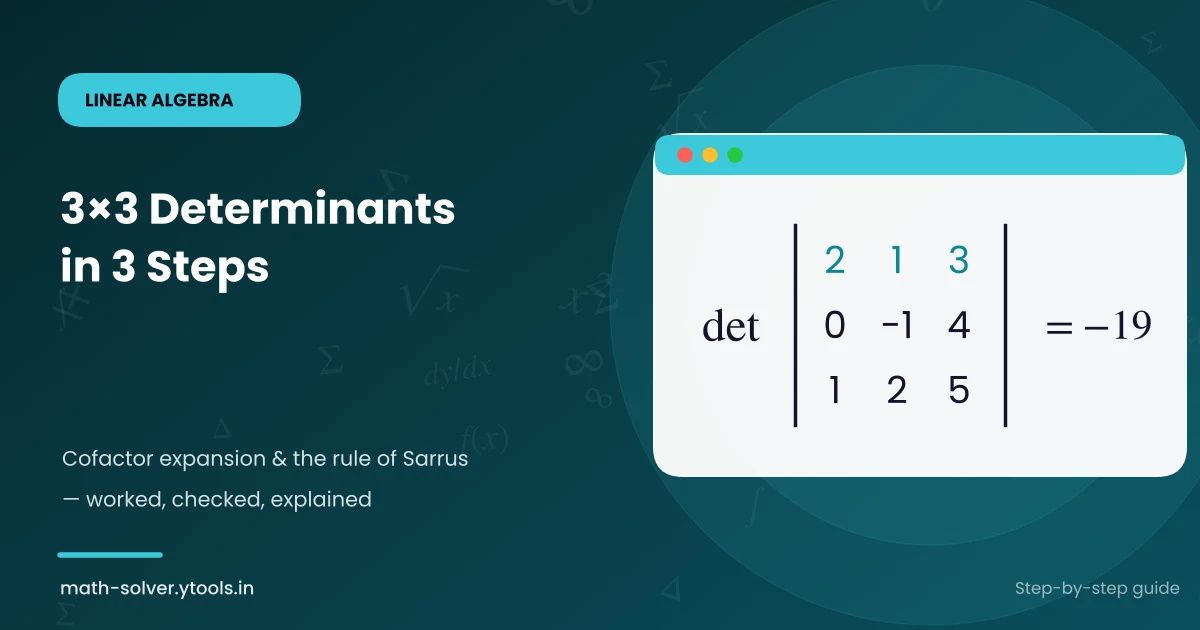
How to Find the Determinant of a 3×3 Matrix (Step by Step)
Find any 3×3 determinant with cofactor expansion, then check it with the rule of Sarrus. Fully worked example, sign pattern, shortcuts and what a zero determinant means.
Read More