How to Solve Quadratic Equations Step by Step (With Examples)

A quadratic equation can always be solved — the only question is which method is quickest. This guide shows the one method that works every time (the quadratic formula), the single number that tells you what kind of answer to expect (the discriminant), and two shortcuts for when the numbers are friendly. Every example is fully worked and checked.
What is a quadratic equation?
A quadratic equation is any equation that can be written in standard form
The highest power of is 2. Its graph is a parabola, and the solutions (also called roots) are the -values where the parabola meets the -axis. A quadratic has at most two distinct real roots.
The quadratic formula
The "" means you calculate twice — once with and once with — to get both roots.
How to solve a quadratic equation step by step
Step 1 — Write it in standard form and identify a, b, c
Move every term to one side so the other side is 0. Keep the signs with the numbers: in , , not 3.
Step 2 — Calculate the discriminant
. This tells you how many real roots there are before you finish.
Step 3 — Apply the formula
Substitute , and into the formula.
Step 4 — Simplify and check
Simplify both roots and substitute at least one back into the original equation.
What the discriminant tells you
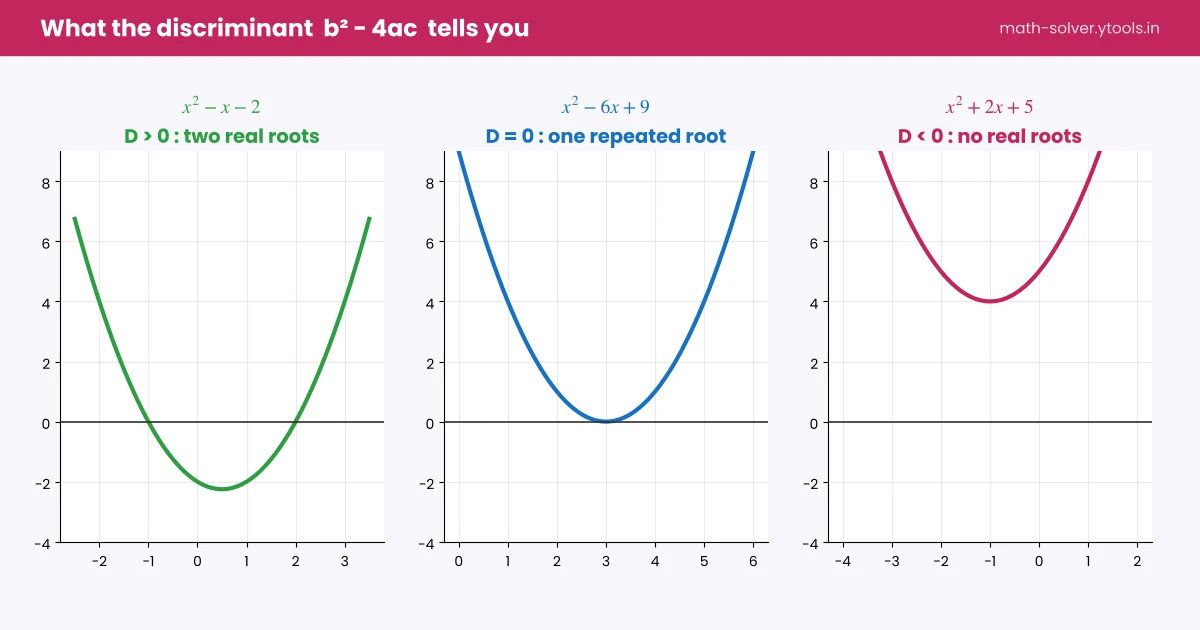
| Discriminant | Number of real roots | What the graph does |
|---|---|---|
| Two different real roots | Crosses the x-axis twice | |
| One repeated real root | Touches the x-axis once | |
| No real roots (two complex roots) | Never reaches the x-axis |
If is a perfect square (1, 4, 9, 16, 25, 49…), the roots are rational and the quadratic can also be factored.
Worked examples
Two real roots:
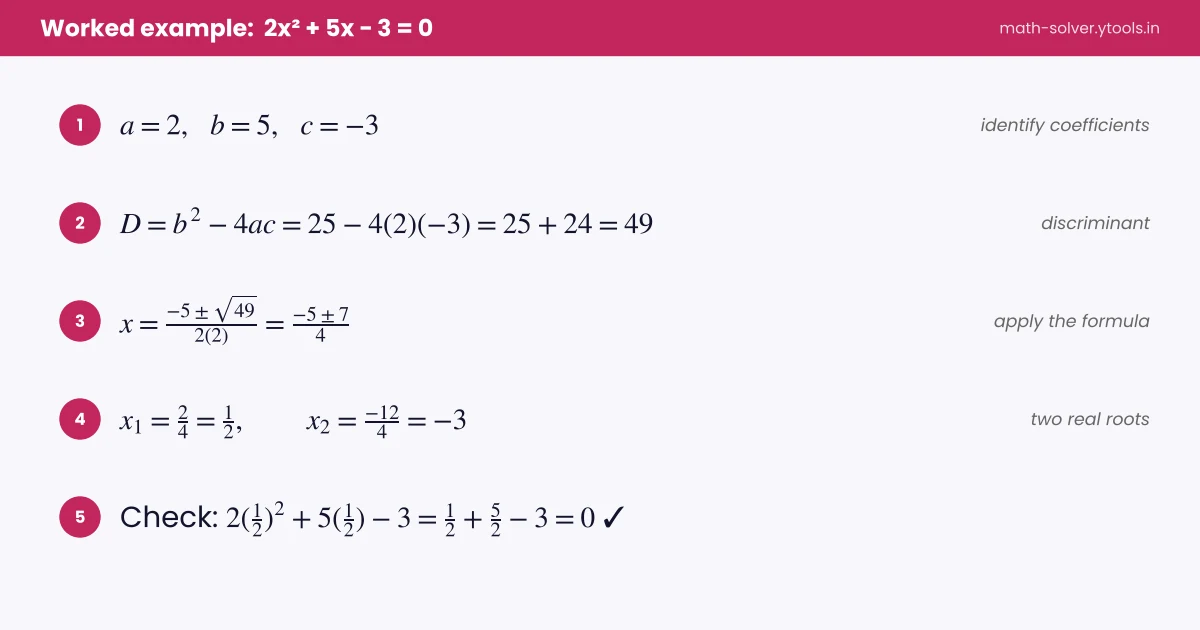
- , ,
- → two real roots, and 49 is a perfect square
- and
- Check : ✓. Check : ✓
One repeated root:
, , . , so . This is a perfect square: .
Complex roots:
. There are no real roots. Using : . If your course only works with real numbers, the answer is simply "no real solutions".
Faster methods when they work
Factoring:
Find two numbers that multiply to and add to : they are and . So , giving or .
Completing the square:
Move the constant: . Add to both sides: . So , giving or . (Completing the square on in general is how the quadratic formula is derived.)
Quick check: sum and product of roots
For , the roots satisfy and . For : ✓ and ✓. Ten seconds, and you know both roots are right.
Common mistakes
- Using the wrong sign for (or ) — copy signs with the numbers.
- Writing instead of : is always non-negative, even when is negative.
- Dividing only by instead of the whole numerator.
- Forgetting to set the equation equal to zero before reading off , , .
- Stopping after one root.
Use the quadratic equation calculator
Enter , and into the quadratic equation calculator to see the discriminant and each step. If a root involves a surd, the square root calculator helps simplify it. New to equations? Start with solving linear equations.
FAQ
What is the quadratic formula? , which gives the roots of for .
How do I solve a quadratic equation step by step? Write it as , identify , , , calculate , substitute into the formula, then simplify and check.
What happens when the discriminant is zero? There is exactly one (repeated) real root, , and the parabola just touches the x-axis.
What if the discriminant is negative? There are no real roots; the two roots are complex numbers.
Is factoring or the quadratic formula better? Factoring is faster when the discriminant is a perfect square; the formula always works.
Can an online calculator show the steps? Yes — the quadratic equation calculator shows the discriminant and full working.
Conclusion
Put the equation in standard form, compute the discriminant, apply the formula and check with the sum and product of the roots. When the discriminant is a perfect square, factoring is a quicker route to the same answer.
Further reading: Wolfram MathWorld — Quadratic Formula, Discriminant · OpenStax College Algebra 2e.
Related Posts
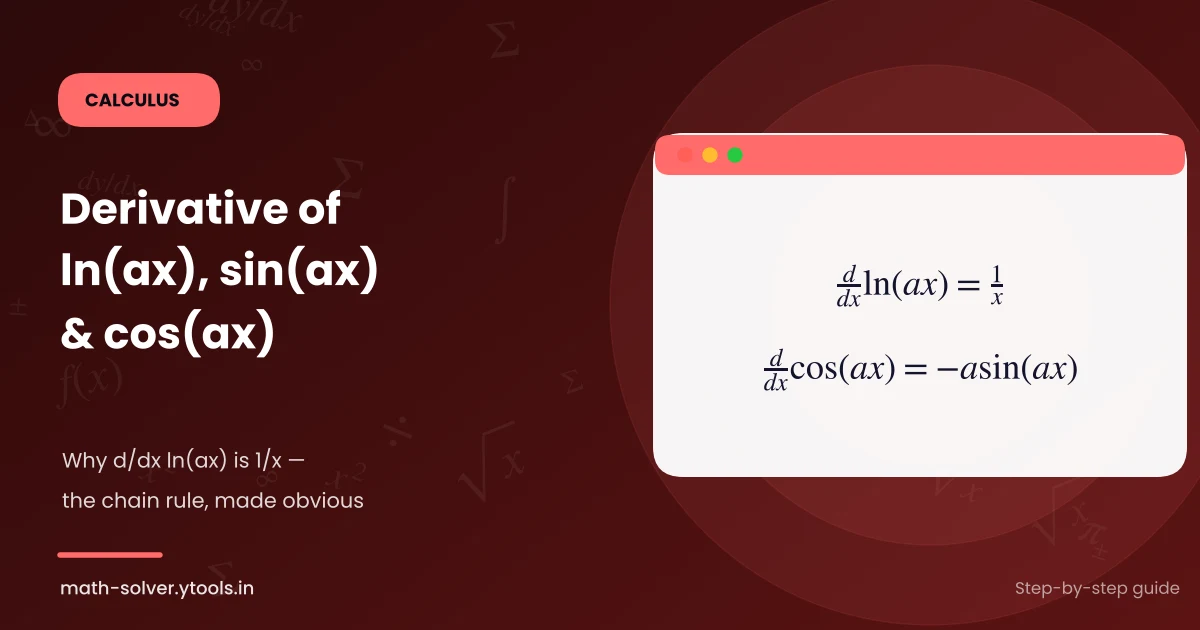
Derivative of ln(ax), sin(ax), cos(ax): Chain Rule Explained
Why d/dx ln(ax) = 1/x, why sin(ax) gives a·cos(ax) and cos(ax) gives −a·sin(ax). One chain-rule pattern, a graph that makes it obvious, and worked examples.
Read More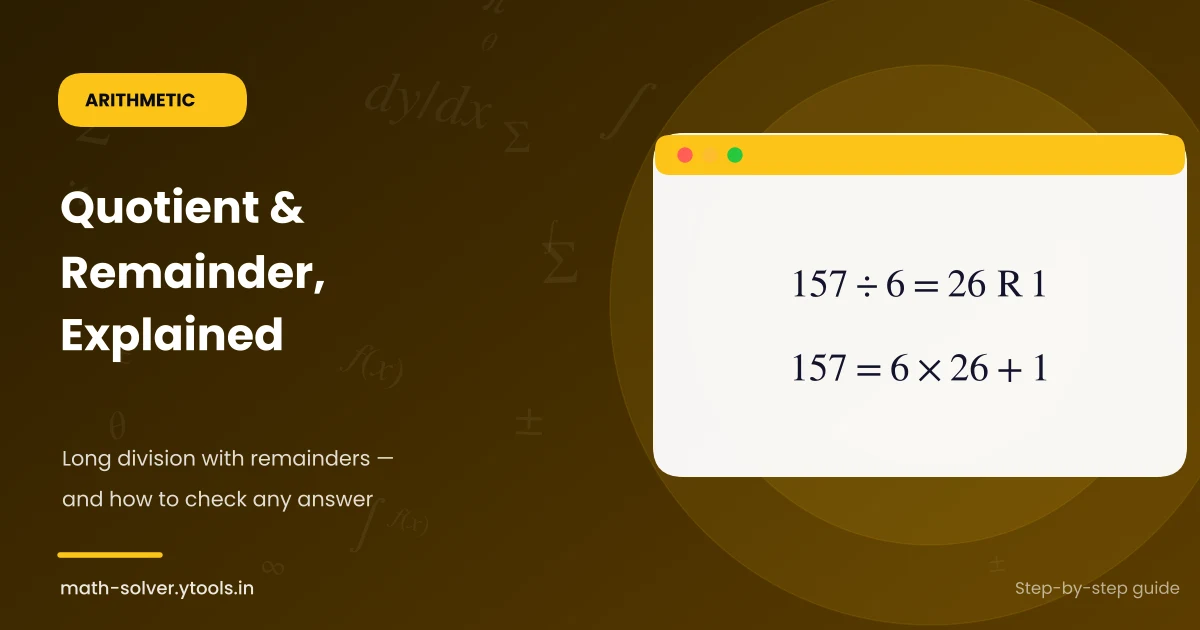
How to Divide With Remainders: Quotient & Remainder Explained
Learn to find the quotient and remainder with long division, check answers with dividend = divisor × quotient + remainder, and write remainders as fractions or decimals.
Read More
How to Find the Determinant of a 3×3 Matrix (Step by Step)
Find any 3×3 determinant with cofactor expansion, then check it with the rule of Sarrus. Fully worked example, sign pattern, shortcuts and what a zero determinant means.
Read More