How to Solve Simultaneous Equations: Substitution vs Elimination
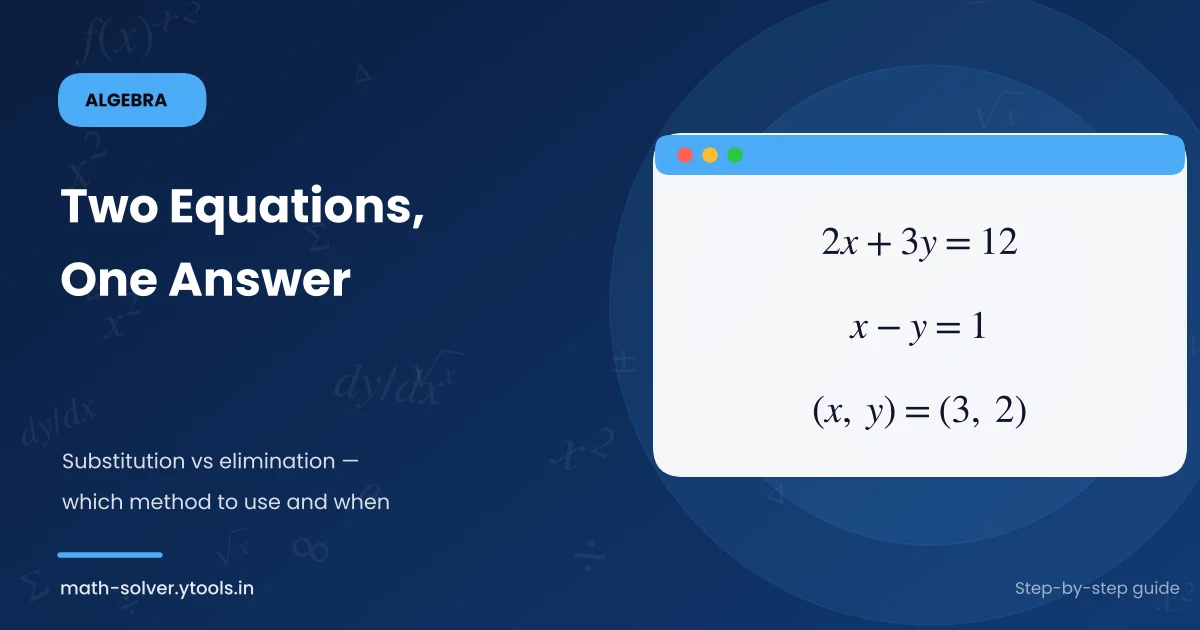
Simultaneous equations are two (or more) equations that must be true at the same time. With two unknowns you need two equations, and the solution is the pair of values that satisfies both. This guide covers the two everyday methods — substitution and elimination — plus Cramer's rule, the special cases, and how to check your answer.
What "simultaneous" means
Each linear equation in and is a straight line. The solution is the point where the lines cross.
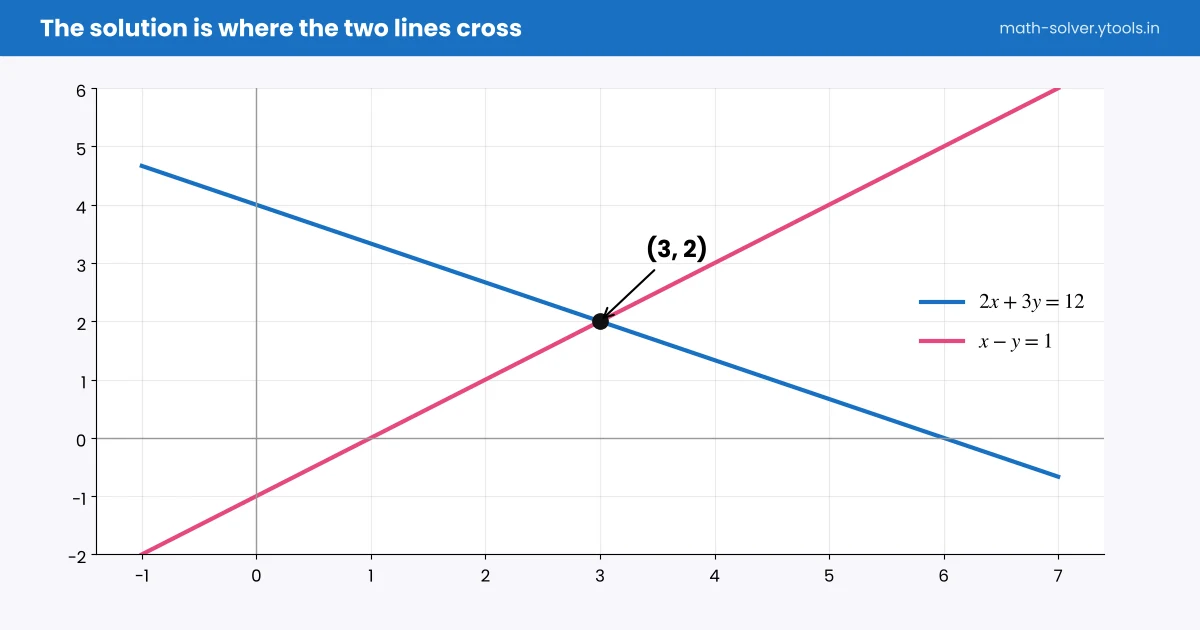
For and , the lines meet at : that is, and . Graphs are a good picture but slow and imprecise; algebra gives exact answers.
Method 1 — Substitution
Solve one equation for one variable, then substitute that expression into the other equation.
Worked example: and
- The second equation is easy to rearrange: .
- Substitute into the first: .
- Expand and solve: .
- Back-substitute: .
- Check both equations: ✓ and ✓.
Step 3 is just a one-variable equation — see solving one equation for x if that part is shaky.
Method 2 — Elimination
Add or subtract the equations so that one variable cancels out.
Worked example: and
- The -coefficients are and , so add the equations: .
- .
- Substitute into the first equation: .
- Check: ✓.
When you must multiply first: and
No coefficients match, so make them match. Multiply the first equation by 3 and the second by 2:
Subtract: , so . Then . Check: ✓.
Which method should you use?
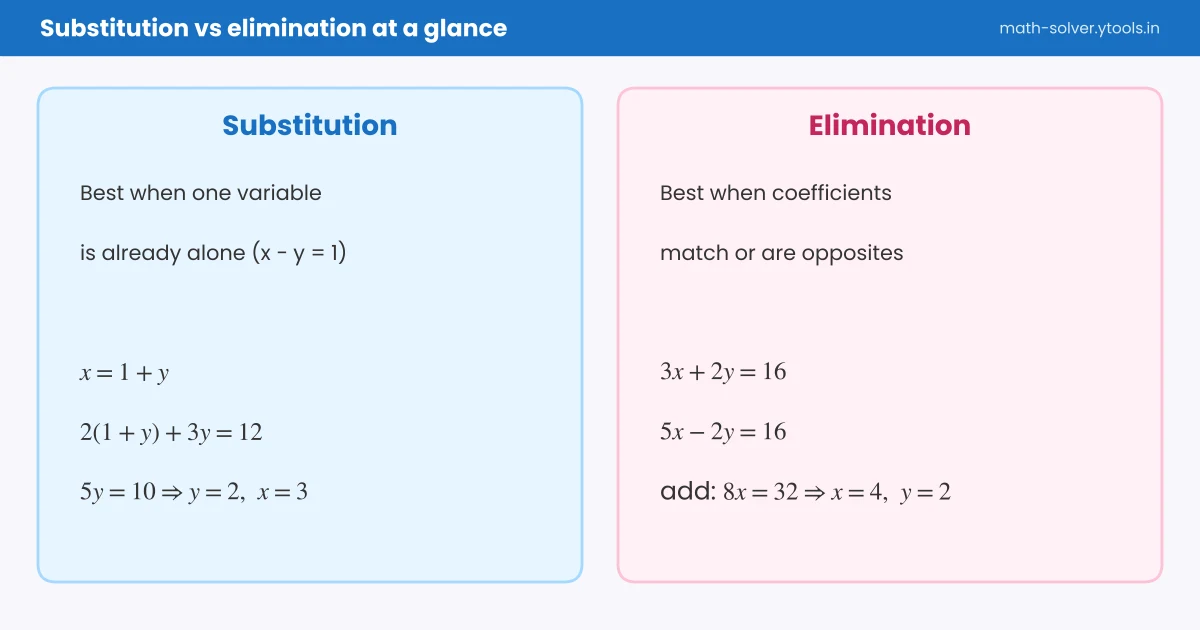
| Use substitution when… | Use elimination when… |
|---|---|
| one variable already has a coefficient of 1 or −1 () | coefficients already match or are opposites |
| one equation is already solved for a variable () | both equations are in the form |
| the system is non-linear (e.g. a line and a curve) | substitution would create messy fractions |
Both methods always give the same answer, so you can use one to check the other.
Method 3 — Cramer's rule (using determinants)
For and :
For , : , , . So and ✓. Cramer's rule needs and extends to three unknowns using 3×3 determinants. The 2×2 determinant calculator speeds up the arithmetic.
No solution and infinitely many solutions
| System | What happens | Lines | Solutions |
|---|---|---|---|
| , | subtracting gives (false) | parallel | none (inconsistent) |
| , | the second is 2 × the first; you get | the same line | infinitely many (dependent) |
In both cases , which is why Cramer's rule can't be used.
A word problem
Two pens and three notebooks cost 12. A pen costs 1 more than a notebook. Find each price.
Let = pen price and = notebook price: and . That's our first example, so a pen costs 3 and a notebook costs 2. Check: ✓.
Common mistakes
- Substituting back into the equation you rearranged (it will always "check") — check in both original equations.
- Subtracting equations but forgetting to subtract every term, especially negatives.
- Multiplying only one side of an equation when scaling it.
- Stopping after finding one variable.
Use the simultaneous equations calculator
Enter both equations in the simultaneous equations calculator to see a full solution, or use the linear equation solver for the single-variable step.
FAQ
How do you solve simultaneous equations? Use substitution (rearrange one equation and substitute into the other) or elimination (add/subtract the equations to cancel one variable), then back-substitute and check.
Which is easier, substitution or elimination? Substitution when a variable has coefficient 1; elimination when coefficients match or can easily be made to match.
How do I know if there is no solution? If eliminating a variable leaves a false statement like , the lines are parallel and there is no solution.
Can simultaneous equations have infinitely many solutions? Yes, when both equations describe the same line — eliminating gives .
How do I check my answer? Substitute both values into both original equations.
Is there a simultaneous equations calculator with steps? Yes — the simultaneous equations calculator shows the full working.
Further reading: Wolfram MathWorld — Linear System of Equations · OpenStax Elementary Algebra 2e, chapter 5.
Related Posts
Derivative of ln(ax), sin(ax), cos(ax): Chain Rule Explained
Why d/dx ln(ax) = 1/x, why sin(ax) gives a·cos(ax) and cos(ax) gives −a·sin(ax). One chain-rule pattern, a graph that makes it obvious, and worked examples.
Read More
How to Divide With Remainders: Quotient & Remainder Explained
Learn to find the quotient and remainder with long division, check answers with dividend = divisor × quotient + remainder, and write remainders as fractions or decimals.
Read More
How to Find the Determinant of a 3×3 Matrix (Step by Step)
Find any 3×3 determinant with cofactor expansion, then check it with the rule of Sarrus. Fully worked example, sign pattern, shortcuts and what a zero determinant means.
Read More