Expense Categories: How to Categorize Your Spending
Every useful number in personal finance (your biggest expense, your savings rate, where you overspent) depends on one thing: putting each transaction into the right category. Get categories wrong and every analysis after that is distorted.
This guide gives you a simple four-group system, a complete category list you can copy, and rules for the transactions that are hard to place.
Why expense categories matter
Categories turn hundreds of transactions into a handful of totals you can actually read. Good categories:
- Show you where the money goes at a glance
- Let you compare months, as long as they stay the same
- Make budgets possible, since a budget is just a limit per category
- Separate costs you can change quickly from costs you can't
The four groups
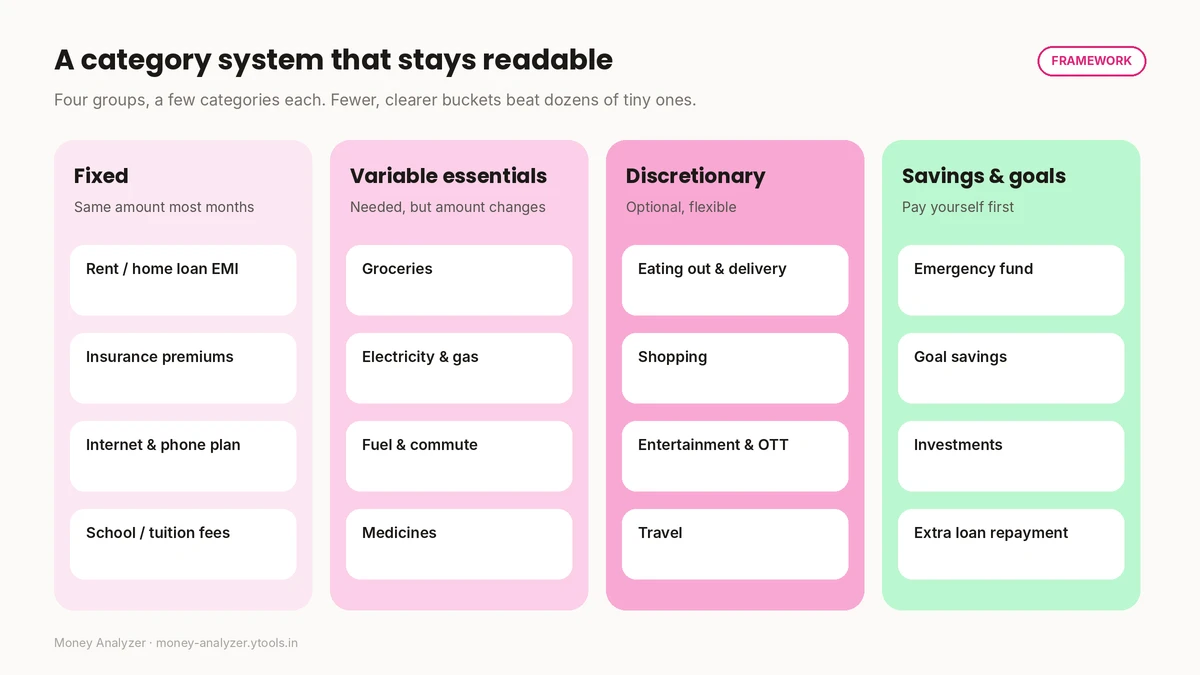
1. Fixed expenses
Roughly the same amount every month and hard to change quickly: rent or home-loan EMI, insurance premiums, internet and phone plans, school or tuition fees.
2. Variable essentials
Necessary, but the amount changes: groceries, electricity and gas, fuel and commuting, medicines.
3. Discretionary spending
Optional and flexible: eating out and delivery, shopping, entertainment and streaming, travel.
4. Savings and goals
Money you deliberately set aside: emergency fund, goal savings, investments, extra loan repayments. Treating savings as a category, not as "whatever's left", makes it visible.
A complete expense category list
Copy this list and remove anything that doesn't apply to you:
textFIXED                     VARIABLE ESSENTIALS       DISCRETIONARY             SAVINGS & GOALS
Rent / Home loan EMI      Groceries                 Eating out                Emergency fund
Other loan EMIs           Electricity               Food delivery             Goal savings
Insurance premiums        Water & gas               Shopping (clothes, etc.)  Investments
Internet & mobile         Fuel / commute            Entertainment & OTT       Extra loan repayment
School / tuition fees     Medicines & doctor        Travel & holidays
Domestic help             Household supplies        Hobbies
                          Personal care             Gifts & celebrations

OTHER (keep under ~10% of spending): One-off or uncategorized items — review monthly
Example: needs, wants and savings
Example. The numbers below are illustrative, not real-world statistics.
Once transactions are categorized, you can roll the four groups into three bigger buckets: needs (fixed + variable essentials), wants (discretionary) and savings. For a take-home pay of ₹50,000:
| Bucket | Amount | Share of take-home |
|---|---|---|
| Needs | ₹27,500 | 55% |
| Wants | ₹12,500 | 25% |
| Savings | ₹10,000 | 20% |
| Total | ₹50,000 | 100% |
textNeeds share   = ₹27,500 ÷ ₹50,000 × 100 = 55%
Wants share   = ₹12,500 ÷ ₹50,000 × 100 = 25%
Savings share = ₹10,000 ÷ ₹50,000 × 100 = 20%
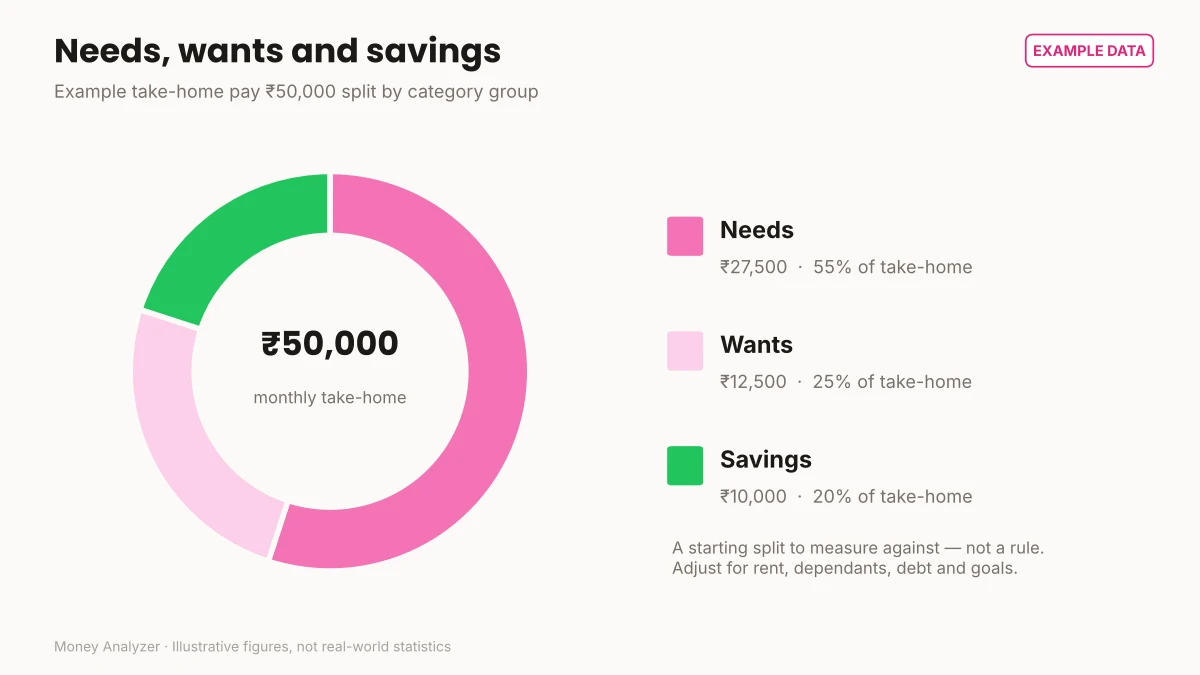
You may have seen the popular "50/30/20" rule of thumb (50% needs, 30% wants, 20% savings). It's a useful reference point, not a standard. In this example, needs take 55% because of rent; that isn't "wrong", it's just information. In high-rent cities or with dependants or EMIs, needs often take more.
Rules for tricky transactions
| Transaction | Where it goes |
|---|---|
| Credit card bill payment | Not an expense. Categorize the individual purchases on the card instead |
| Transfer to your own savings account | Savings (not spending) |
| UPI transfer to a friend for a shared dinner | Eating out (your share), or "Reimbursable" if they'll pay you back |
| Amazon/marketplace orders | By what you bought (groceries, household, shopping), not by the store |
| Annual insurance premium | Fixed; for monthly budgeting, also set aside one-twelfth each month |
| ATM cash withdrawal | Ideally split by what the cash was spent on; otherwise "Cash — misc." |
| Refunds | Subtract from the original category |
The principle: categorize by what the money was for, not where it was paid.
How many categories should you have?
Usually 8–15. Fewer and you can't see where problems are; many more and categorizing becomes a chore you'll stop doing. Start broad and split a category only when it gets big enough that you want to understand it (for example, splitting "Food" into "Groceries" and "Delivery").
Common mistakes
- Counting the credit card payment and the purchases. That's double-counting.
- A huge "Miscellaneous" category. If it's over about 10% of spending, split it.
- Changing categories every month. Comparisons stop working.
- Categorizing by merchant instead of purpose.
How Money Analyzer can help
Money Analyzer tracks expenses by category and shows them as charts, so once your categories are set, the breakdown builds itself. Next step: analyze your monthly expenses using these categories. Review the privacy policy before entering financial data.
Frequently asked questions
What are the main expense categories?
Most personal budgets use four groups: fixed expenses (rent, EMIs, insurance), variable essentials (groceries, utilities, transport), discretionary spending (eating out, shopping, entertainment) and savings.
What's the difference between fixed and variable expenses?
Fixed expenses stay roughly the same each month (rent, EMIs). Variable expenses change with usage or choices (groceries, fuel, electricity).
Is the 50/30/20 rule right for me?
It's a rule of thumb, not a requirement. Use it as a starting point to compare against, then adjust for your rent, dependants, debts and goals.
Where should I put subscriptions?
Either in their own "Subscriptions" category, which makes them easy to audit, or under Entertainment. A separate category is usually more useful. See How to Find Unnecessary Expenses.
Should savings be a category?
Yes. Treating savings as a planned category, rather than whatever is left at month end, makes it easier to track and protect.
How do I categorize cash spending?
Note it as you go if you can. If not, estimate at month end by purpose ("roughly ₹1,500 vegetables, ₹500 auto"). An estimate is better than a gap.
Conclusion
A good category system is simple, stable and organized by purpose. Use the four groups, copy the list above, follow the rules for tricky transactions, and keep the categories the same month to month. Every other analysis becomes easier.
Get started: set up your categories in Money Analyzer.
This article is general educational information, not personalised financial advice.
Sources: Vikaspedia (Government of India), Household budgeting and cash flow management · Consumer Financial Protection Bureau, Your Money, Your Goals toolkit
Related Posts
How to Analyze Bank Statement Spending Safely
Learn to read bank and UPI statements, categorize transactions, and analyze your spending, while keeping OTPs, PINs and account details private.
Read More
How to Analyze Your Spending Habits: Find Your Patterns
Learn how to analyze your spending habits by looking at frequency, timing and triggers. Includes a worked ₹ example and a simple habit-review method.
Read More
Budget vs Actual Spending: How to Analyze the Gap
Compare your budget with actual spending, calculate variance in ₹ and %, and decide what to change. Includes a worked example with every formula shown.
Read More