How to Multiply Decimals Step by Step (With Examples)
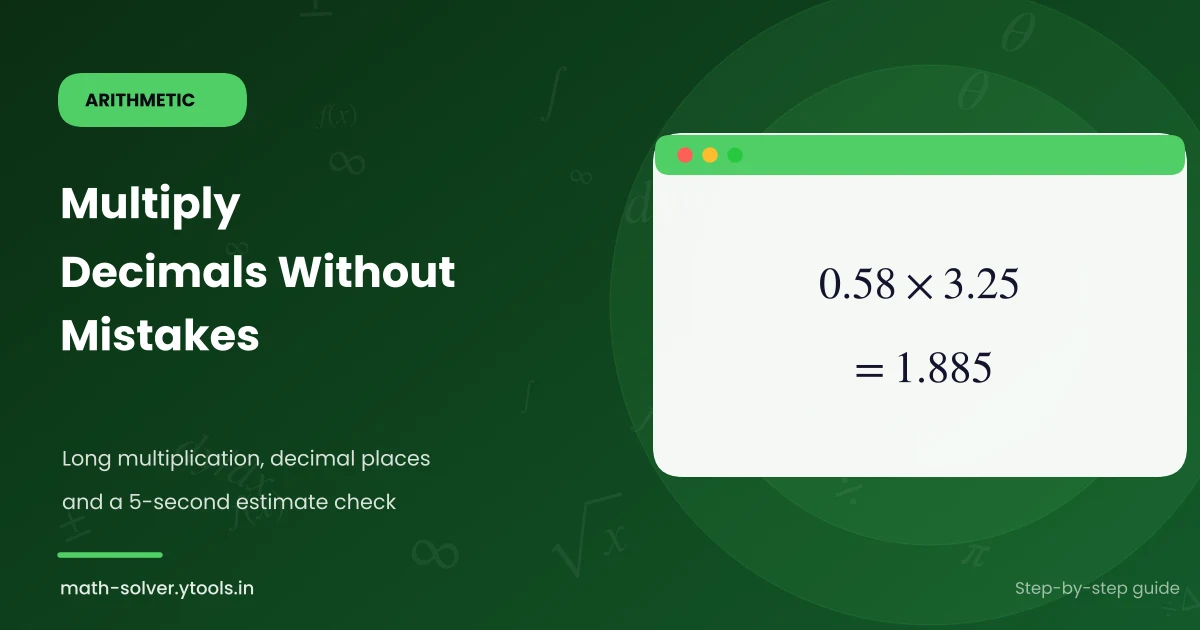
Multiplying decimals feels tricky because of the decimal point — but the point is the last thing you deal with. Multiply as if the numbers were whole, count decimal places to put the point back, then estimate to make sure the answer is the right size. That's the whole method.
The 3-step method
- Multiply as whole numbers. Ignore the decimal points completely.
- Count decimal places. Add up the digits after the point in both numbers.
- Place the point and estimate. Put that many digits after the point in your answer, then compare with a rounded estimate.
Worked example:
Step 1 — Multiply as whole numbers
Remove the points: . Using long multiplication:
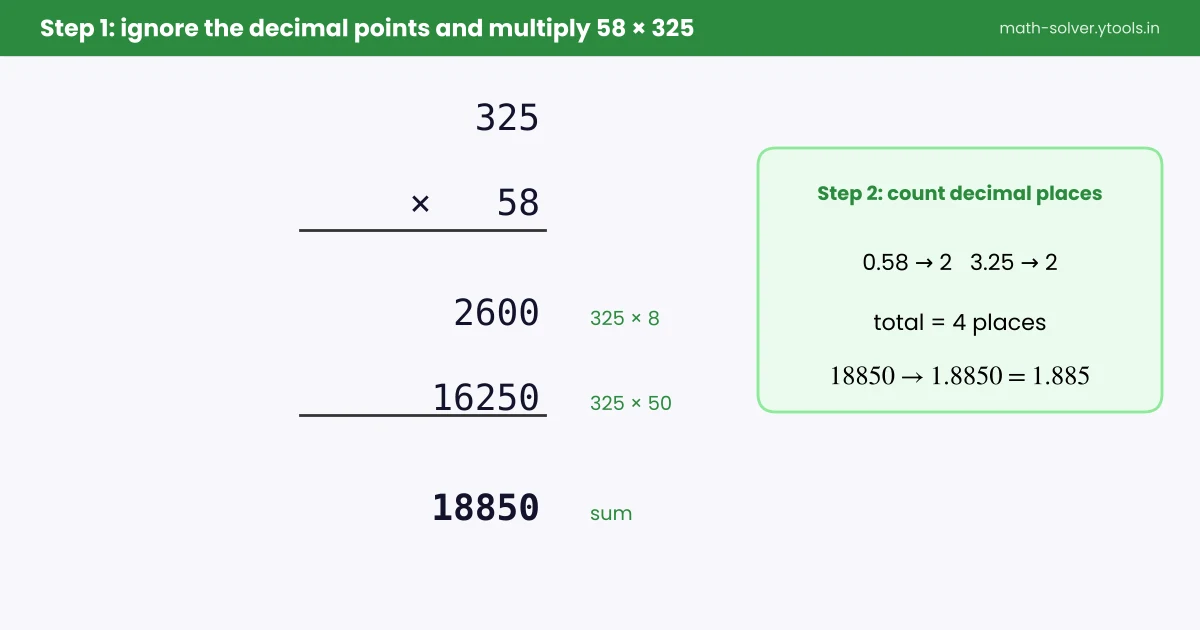
- Add the partial products:
Step 2 — Count decimal places
has 2 decimal places and has 2, so the answer needs decimal places: .
Trailing zeros after the decimal point don't change the value, so .
Step 3 — Estimate to check
Round each factor: and . . Our answer, , is close to — so the decimal point is in the right place. If we had written or , the estimate would catch it instantly.
More examples
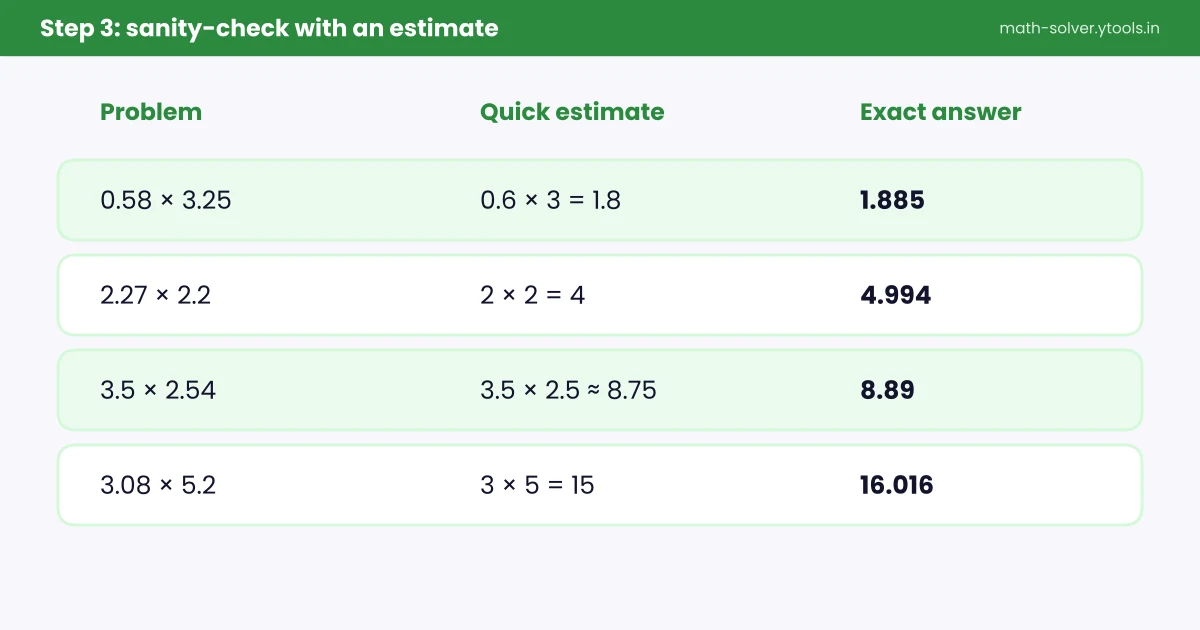
Whole numbers: . Decimal places: . Answer: . Estimate: ✓.
Tiny numbers:
Whole numbers: . Decimal places: . Answer: . Estimate: ✓.
Notice the zeros right after the decimal point in still count as decimal places.
Three decimals:
Multiply two at a time. : , two places → . Then : , three places → . Estimate: , so 85.9 is a sensible size ✓.
When the zeros cancel:
, two places → .
Multiplying by 10, 100 and 0.1
- × 10 moves the point one place right:
- × 100 moves it two places right:
- × 0.1 moves it one place left:
Common mistakes
- Lining up decimal points as you would for addition — not needed for multiplication.
- Counting decimal places in only one number.
- Dropping the leading zeros that hold place value (writing instead of because a digit was lost).
- Skipping the estimate, which is the easiest way to catch a misplaced point.
Use a step-by-step multiplication calculator
To see the full long multiplication for your own numbers, use the step-by-step multiplication calculator. For very small or very large products, the scientific notation calculator keeps the digits manageable. Division is the reverse operation — see dividing with remainders.
FAQ
How do you multiply decimals step by step? Multiply the numbers as whole numbers, count the total decimal places in both factors, and place the decimal point that many digits from the right.
Do I need to line up the decimal points? No. That's for adding and subtracting. For multiplication, only the total count of decimal places matters.
What is 0.58 × 3.25? (from with four decimal places).
Can the answer be smaller than both numbers? Yes, when you multiply by a number less than 1. For example, .
How do I check my answer quickly? Round each number to one significant figure and multiply. Your exact answer should be close to the estimate.
Is there a multiplication calculator with steps? Yes — the step-by-step multiplication calculator shows each partial product.
Further reading: OpenStax Prealgebra 2e, chapter 5 "Decimals".
Related Posts
Derivative of ln(ax), sin(ax), cos(ax): Chain Rule Explained
Why d/dx ln(ax) = 1/x, why sin(ax) gives a·cos(ax) and cos(ax) gives −a·sin(ax). One chain-rule pattern, a graph that makes it obvious, and worked examples.
Read More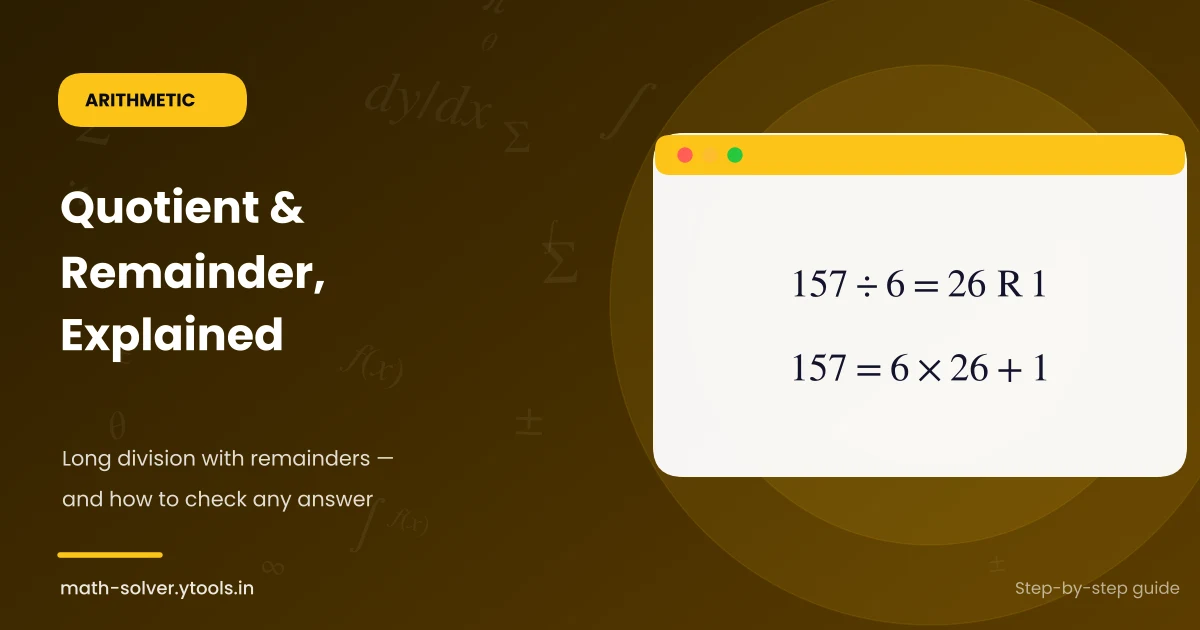
How to Divide With Remainders: Quotient & Remainder Explained
Learn to find the quotient and remainder with long division, check answers with dividend = divisor × quotient + remainder, and write remainders as fractions or decimals.
Read More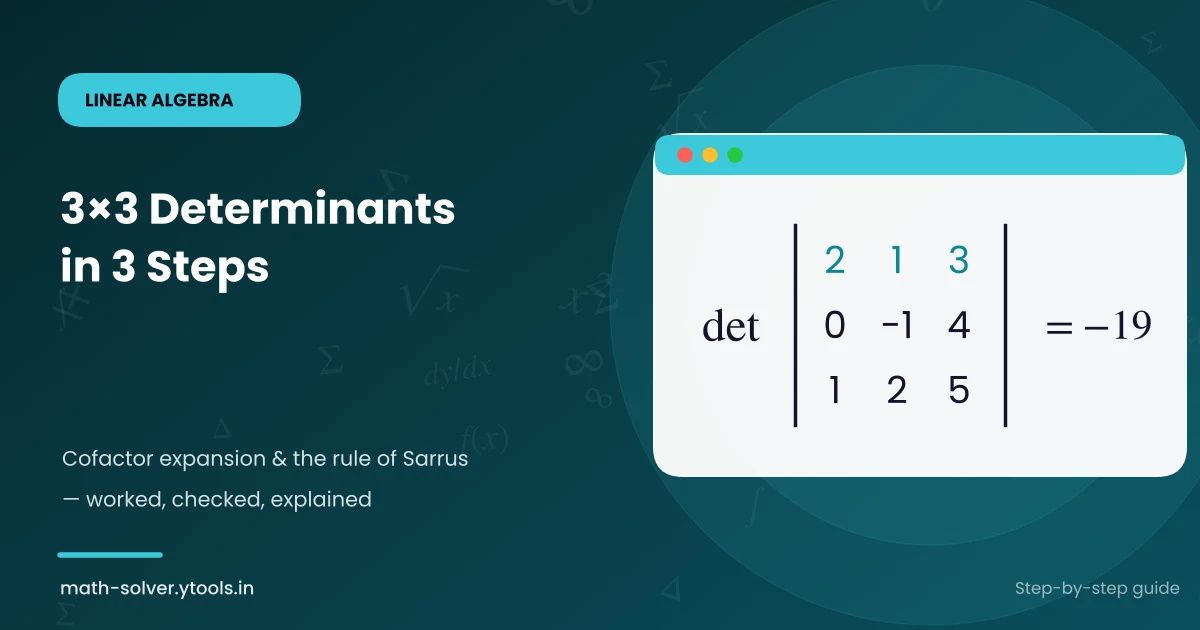
How to Find the Determinant of a 3×3 Matrix (Step by Step)
Find any 3×3 determinant with cofactor expansion, then check it with the rule of Sarrus. Fully worked example, sign pattern, shortcuts and what a zero determinant means.
Read More