Permutation vs Combination: nPr & nCr Formulas With Examples
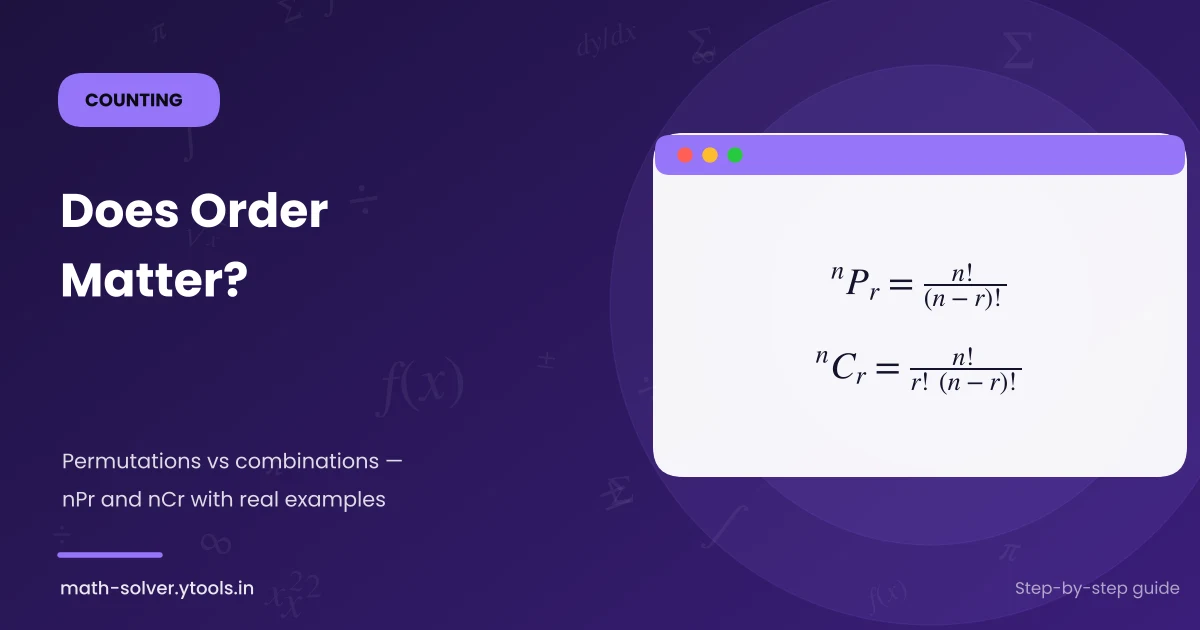
Permutations and combinations both count the ways to choose items from . The difference comes down to a single question — does the order of the chosen items matter? Answer that, and you know which formula to use.
The one-question test: does order matter?
- Yes, order matters → it's a permutation (an arrangement). Gold–silver–bronze is different from bronze–silver–gold.
- No, order doesn't matter → it's a combination (a selection). A team of Asha, Ben and Chen is the same team in any order.
Permutations (nPr)
Formula
where , and .
Example: gold, silver and bronze from 10 runners
There are 10 choices for gold, then 9 for silver, then 8 for bronze: . The formula agrees:
Combinations (nCr)
Formula
nCr is read "n choose r" and is also called the binomial coefficient.
Example: a 3-person committee from 10 people
The committee {Asha, Ben, Chen} is one combination, even though it could be listed in orders.
Seeing the difference: choosing 2 from {A, B, C}
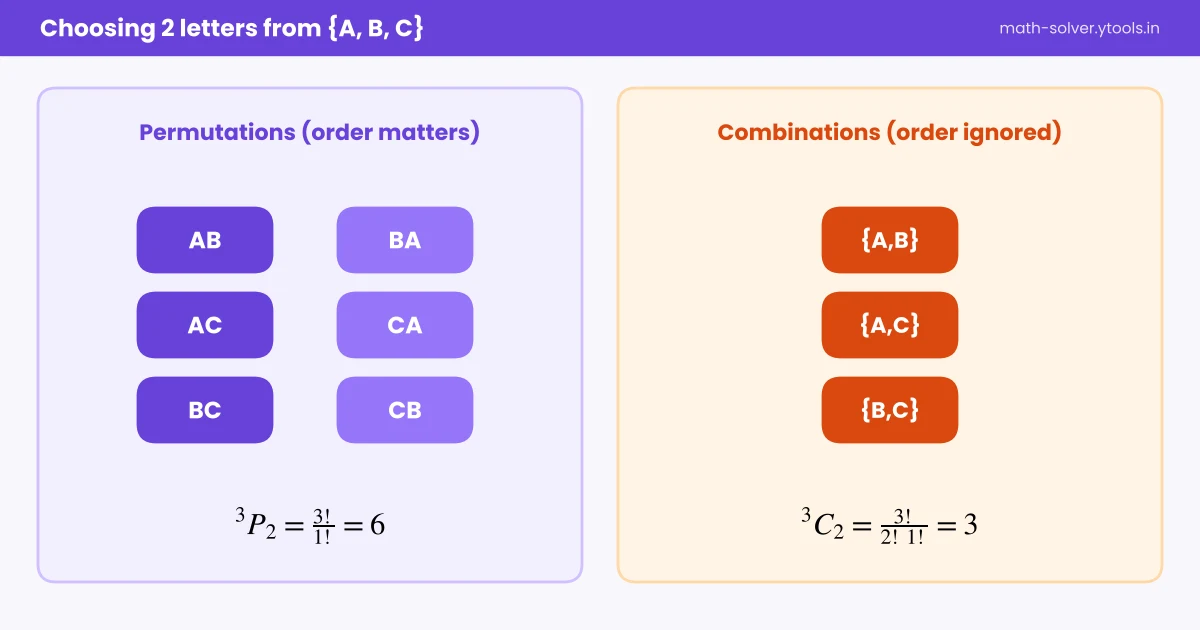
Listing everything makes the difference obvious. The permutations are AB, BA, AC, CA, BC, CB — six, because AB and BA count separately. The combinations are {A,B}, {A,C}, {B,C} — three, because order is ignored. Formulas: and .
How nPr and nCr are connected
Each combination of items can be arranged in orders, so
Check with the running example: ✓. This means nPr is always at least as large as nCr.
Another useful property: . Choosing 3 people for a committee from 10 is the same as choosing the 7 who are left out: .
Quick decision guide
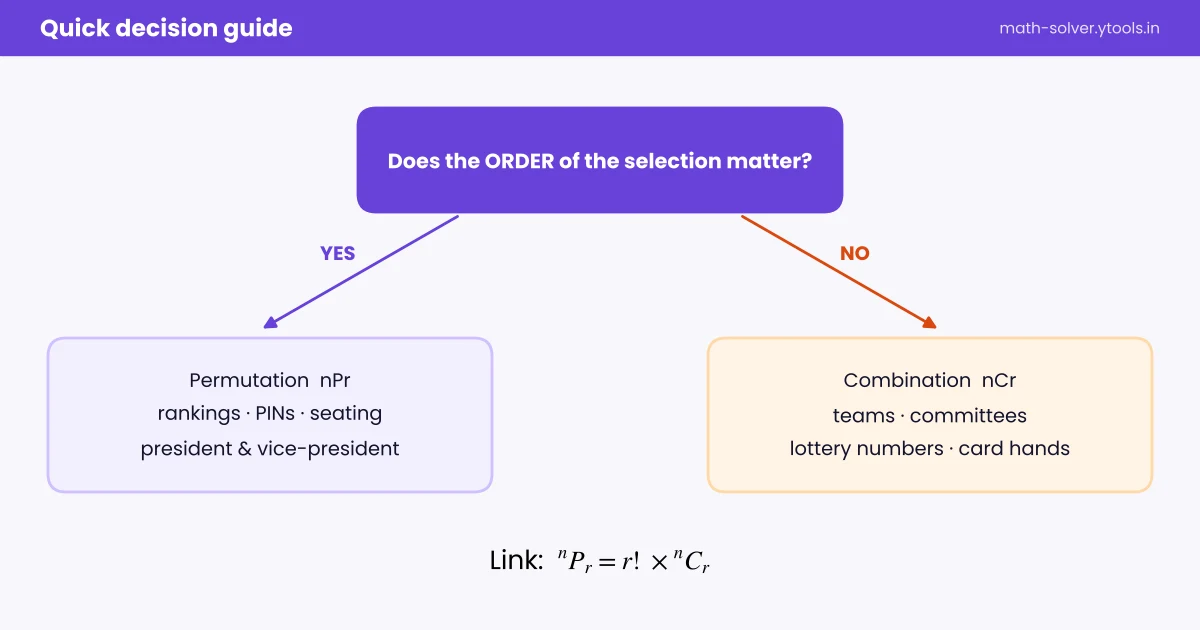
| Situation | Order matters? | Use |
|---|---|---|
| Ranking the top 3 in a race | Yes | nPr |
| Electing a president and a vice-president | Yes (different roles) | nPr |
| Seating 4 people in 4 chairs | Yes | nPr () |
| Picking a 5-a-side team | No | nCr |
| Dealing a 5-card poker hand from 52 cards | No | nCr: |
| Choosing 2 pizza toppings from 5 | No | nCr: |
Tip: if the chosen items get different roles or positions, order matters.
What if repetition is allowed?
nPr and nCr assume each item can be chosen only once. If items can repeat, the counting changes. A 4-digit PIN using digits 0–9 with repetition allowed has possibilities — not , which would forbid repeated digits. (Despite its name, a "combination lock" code is really an ordered arrangement.)
Common mistakes
- Using nCr when positions or roles make order important.
- Forgetting the in the denominator of nCr.
- Using nPr or nCr when repetition is allowed.
- Calculating huge factorials in full — cancel first: .
Use the nPr and nCr calculators
Try your own values with the permutations (nPr) calculator and the combinations (nCr) calculator. For more practice on the combinations formula alone, see nCr formula with worked examples. nCr also appears in probability — the binomial probability calculator uses it — and the factorial calculator handles directly.
FAQ
What is the difference between a permutation and a combination? In a permutation the order of the chosen items matters; in a combination it doesn't.
What is the nCr formula? .
What is the nPr formula? .
Is nPr always bigger than nCr? nPr is always greater than or equal to nCr, because and . They are equal only when or .
What does 0! equal? , which makes formulas like work.
How many ways can I choose 3 from 10? 120 if order doesn't matter (); 720 if it does ().
Further reading: Wolfram MathWorld — Permutation, Combination, Binomial Coefficient.
Related Posts
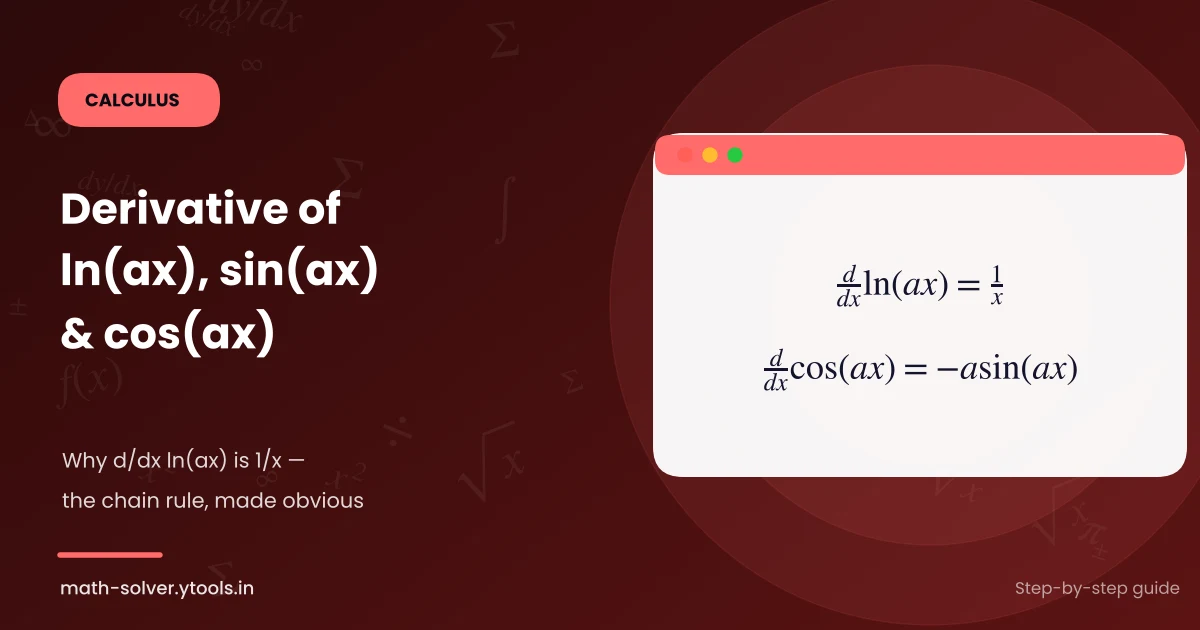
Derivative of ln(ax), sin(ax), cos(ax): Chain Rule Explained
Why d/dx ln(ax) = 1/x, why sin(ax) gives a·cos(ax) and cos(ax) gives −a·sin(ax). One chain-rule pattern, a graph that makes it obvious, and worked examples.
Read More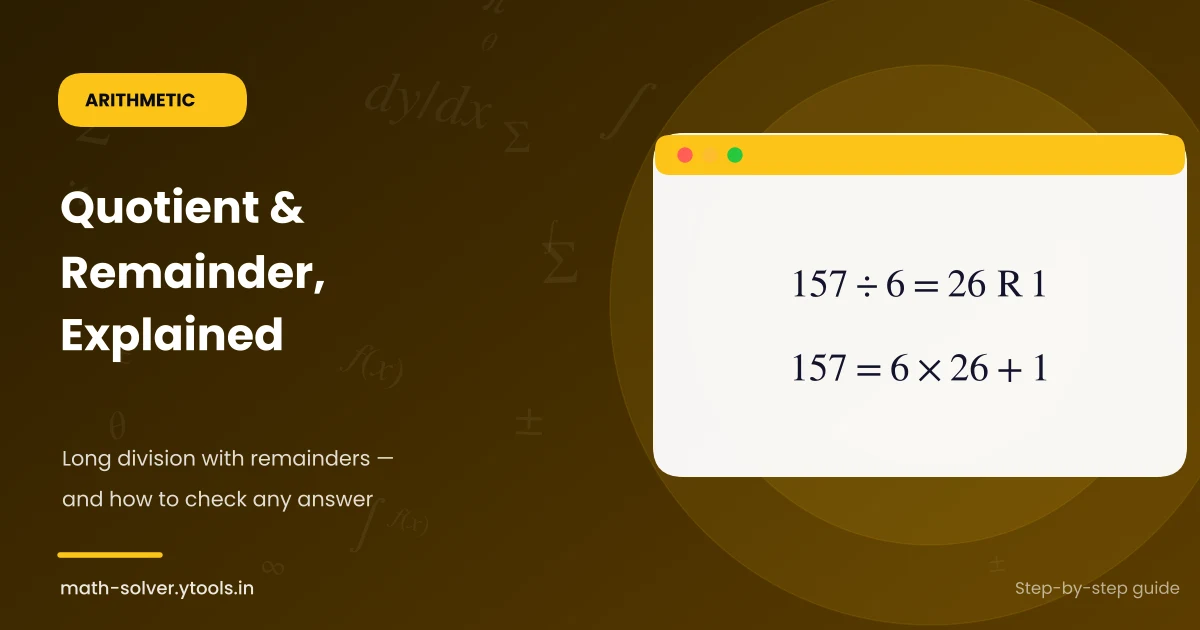
How to Divide With Remainders: Quotient & Remainder Explained
Learn to find the quotient and remainder with long division, check answers with dividend = divisor × quotient + remainder, and write remainders as fractions or decimals.
Read More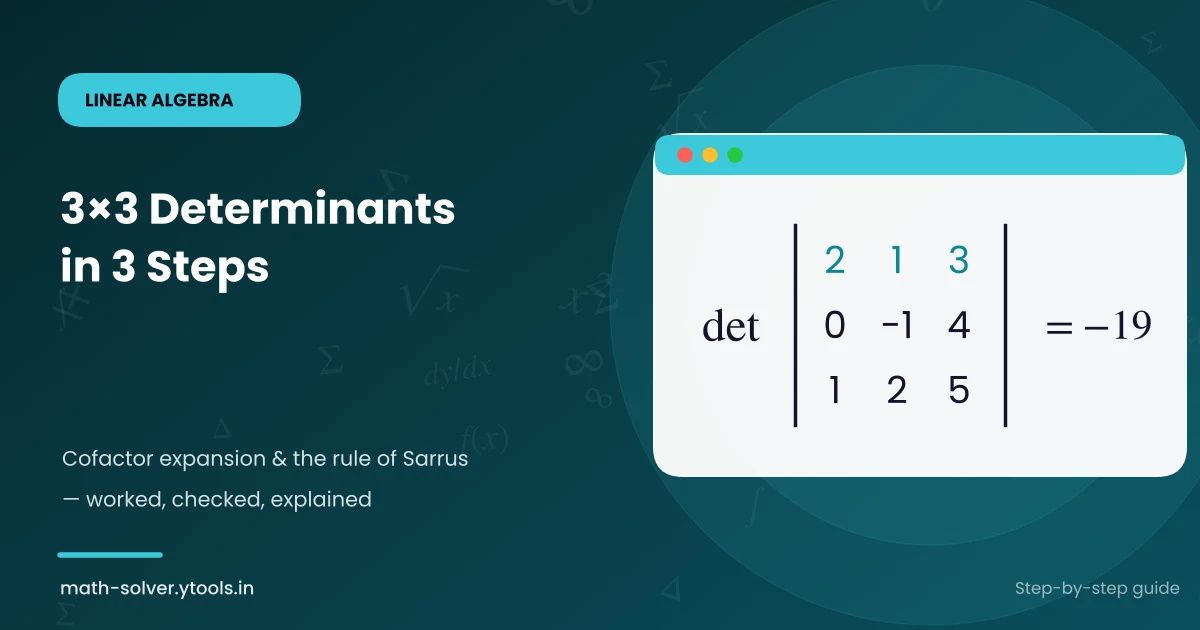
How to Find the Determinant of a 3×3 Matrix (Step by Step)
Find any 3×3 determinant with cofactor expansion, then check it with the rule of Sarrus. Fully worked example, sign pattern, shortcuts and what a zero determinant means.
Read More